


 Dollar Near Two-Week High as Stock Rout, AI Concerns and Global Events Drive Market Volatility
  UK Starting Salaries See Strongest Growth in 18 Months as Hiring Sentiment Improves
  Best Gold Stocks to Buy Now: AABB, GOLD, GDX
  Asian Currencies Stay Rangebound as Yen Firms on Intervention Talk
  Russian Stocks End Mixed as MOEX Index Closes Flat Amid Commodity Strength
  Japan Economy Poised for Q4 2025 Growth as Investment and Consumption Hold Firm
  Trump Lifts 25% Tariff on Indian Goods in Strategic U.S.–India Trade and Energy Deal
  South Africa Eyes ECB Repo Lines as Inflation Eases and Rate Cuts Loom
  Asian Stocks Slip as Tech Rout Deepens, Japan Steadies Ahead of Election
  U.S. Stock Futures Rise as Markets Brace for Jobs and Inflation Data


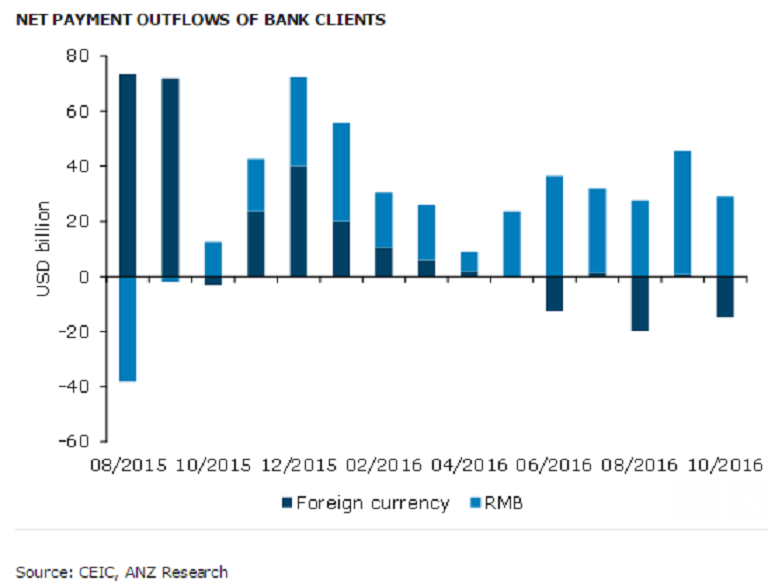
Capital outflows from China have increased over the past few months, averaging to SD24 billion a month since May. But the net payments are dominated in RMB instead of in the USD. In fact, banks report net receipts in foreign currency (mostly in USD). This is consistent with the decline in foreign exchange buying by banks' clients (October: -20 percent y/y) in the onshore market.
Chinese regulators will tighten the capital flows in yuan and foreign exchange operations of local financial institutions. As onshore buying of foreign currency becomes increasingly difficult, Chinese residents will be encouraged to send funds in the local currency for conversion abroad. Thus the offshore market will face stronger yuan depreciation pressure. This may trigger some regulatory actions to tighten the RMB outflows, ANZ reported.
The policy stance of China's central bank seems to have shifted from directly managing the exchange rate to preserving foreign reserves. On one hand, the central bank has adopted the policy to adjust RMB exchange rate with reference to a basket of currencies.
The People's Bank of China (PBoC) seems to have a higher tolerance for exchange rate flexibility and allow the yuan to weaken in light of USD strengthening. On the other hand, the State Council is reportedly tightening overseas investment activities and acquisitions of Chinese enterprises. The authorities seem to be targeting the quantity of cross border flows.
"In our view, China should strengthen the use of interest rate instruments to influence the yuan exchange rate indirectly if the country continues to commit to capital account liberalization," the report said.
Meanwhile, the USD/CNY currency pair has formed a bearish engulfing pattern at 6.88, down 0.22 percent and having support at 6.85-6.87, while resistance is maintained at 6.89-6.91.













