


 FDA Targets Hims & Hers Over $49 Weight-Loss Pill, Raising Legal and Safety Concerns
  6 simple questions to tell if a ‘finfluencer’ is more flash than cash
  Asian Markets Surge as Japan Election, Fed Rate Cut Bets, and Tech Rally Lift Global Sentiment
  Indian Refiners Scale Back Russian Oil Imports as U.S.-India Trade Deal Advances
  Washington Post Publisher Will Lewis Steps Down After Layoffs
  India–U.S. Interim Trade Pact Cuts Auto Tariffs but Leaves Tesla Out
  Why financial hardship is more likely if you’re disabled or sick
  American Airlines CEO to Meet Pilots Union Amid Storm Response and Financial Concerns
  Sony Q3 Profit Jumps on Gaming and Image Sensors, Full-Year Outlook Raised
  SpaceX Pushes for Early Stock Index Inclusion Ahead of Potential Record-Breaking IPO
  Britain has almost 1 million young people not in work or education – here’s what evidence shows can change that
  Once Upon a Farm Raises Nearly $198 Million in IPO, Valued at Over $724 Million
  Locked up then locked out: how NZ’s bank rules make life for ex-prisoners even harder
  CK Hutchison Launches Arbitration After Panama Court Revokes Canal Port Licences
  Samsung Electronics Shares Jump on HBM4 Mass Production Report
  Weight-Loss Drug Ads Take Over the Super Bowl as Pharma Embraces Direct-to-Consumer Marketing


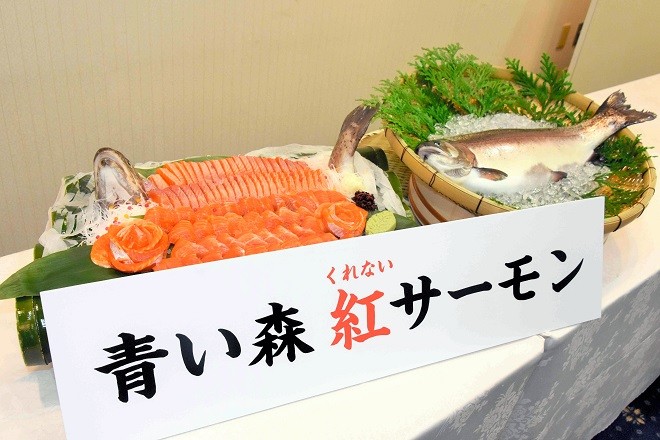
Fierce competition between brands in Aomori and Iwate prefectures has been likened to the “regional wars” in the feudal era as salmon farming has spread so rapidly in these areas.
Around 70 percent of the 300,000 tons of salmon that reach the Japanese market annually are from fish farms.
Japanese consumers had previously been unable to acquire salmon on their tables except through imports from Northern Europe and Chile.
In conveyor belt sushi restaurants, farmed salmon is now more popular than skipjack tuna.
Salmon farming in those regions is often managed by local fishermen and municipalities, as opposed to large-scale agriculture enterprises run by major businesses.
Kohaku Salmon, the Aoimori Kurenai Salmon, and Kaikyo Salmon from Aoimori Prefecture are two of the most recognized salmon brands.
Aoimori Kurenai Salmon, a reduced-fat version of Aoimori Kureha Salmon, was created in a freshwater environment by the Towada-based Inland Water Research Division of the Aomori Prefectural Industrial Technology Research Center (AITC).
For roughly 16 years, the AITC has been developing what it calls a "salmon variety produced in and endemic to Aomori."
Twenty-five possible breeding combinations existed to make a new variant.
The AITC decided to use a rainbow trout strain bred in Aomori for more than 100 years and the huge-growing Donaldson rainbow trout as mother and father when attempting to breed an undesirable flavor out of the offspring of a rainbow trout and a Japanese huchen.
Garlic was originally given as food in Aomori, but it had an overpowering odor. Apples were added to the meal instead, providing the fish a richer and milder flavor with a subtle sweetness.
Kurenai Salmon, a salmon raised in Onomichi, Hiroshima Prefecture, was released in 2020. Sales were 5 tonnes the first year and 12 tons the second year.
The product has been so popular that Aoimori Kurenai Salmon is still difficult to find on the market.
Trout is a kind of salmon, albeit one that is less well-known in Japan than chum salmon.
Japan is home to about a dozen different species of salmon, including chum, coho, pink salmon, and rainbow trout.
A Japanese company, Yamato Salmon Farm Inc., based in Aomori Prefecture, debuted the world's first elastic-fleshed rainbow trout with the intention of capitalizing on the growing demand for farmed salmon that can be eaten raw.
Japan Salmon Farm succeeded in mass-producing a rainbow trout that goes by the name of Aomori Salmon in the market.
Smaller culturing operations conducted by local fishermen and municipalities have recently started up, providing a further boost to the salmon farming sector in Aomori Prefecture.













