


 BTC Flat at $89,300 Despite $1.02B ETF Exodus — Buy the Dip Toward $107K?
  Nasdaq Proposes Fast-Track Rule to Accelerate Index Inclusion for Major New Listings


The demonetization in November 2016 temporarily plunged economic activity in India into chaos. But the effects on the economy have been more muted than expected and should be fully overcome by Q2 2017. The economy looks set to continue growing at a rate of more than 7% in 2017.
Inflation has recently fallen below 4%, but should rise towards the central bank’s inflation target of 5% again in the course of the year.
After adopting a neutral stance as recently as February, the Indian central bank even struck a somewhat hawkish note in April. However, we expect interest rates to remain unchanged in the near term.
In the regional elections in March, the government managed to achieve partly sizeable majorities in most states – despite the demonetization. From the financial markets’ perspective, this was a positive signal, because the government stands for a stability-oriented fiscal policy. This has benefited the INR.
The INR should gradually run out of breath. Rate hikes in the US should trigger a moderate rise of USDINR.
Hedging Strategies:
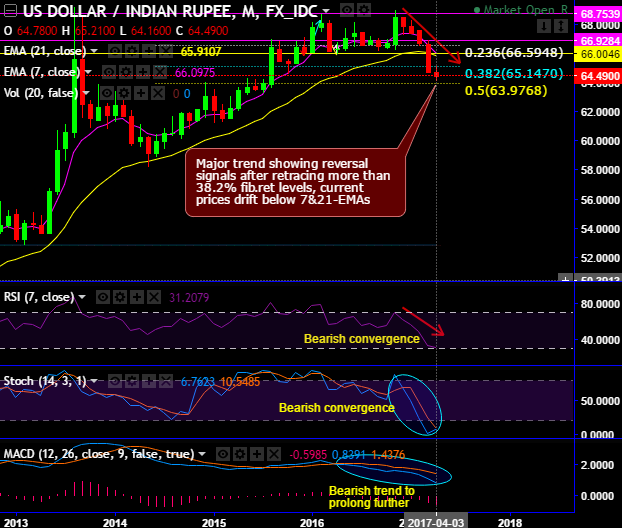
On a broader perspective, USDINR breaks out below 65.1470 (38.2% Fibonacci retracement levels) has indicated that more pullback is likely and bears are likely to resume their primary downtrend.
The current prices on this timeframe have drifted below 7&21-EMAs.
Most importantly, both leading and lagging oscillators are signaling more selling pressures with their bearish convergence to the ongoing price dips. Thereby, it seems that major trend of this pair turning into reversal phase.
Option Trade Tips:
USDINR vol-adjusted carry has jumped back to pre-tapering levels.
So, dubious bulls on hedging grounds, earn carry through 1M USD put spreads.
Enter USDINR put spreads that offer pre-taper tantrum levels of vol-adjusted carry.
Earn carry through 2M USD put spreads.













