Significant Figures is a series from The Conversation where scholars explain an important number in the news.
As the coronavirus pandemic sweeps through the country, more people may find themselves in urgent need of an estate plan.
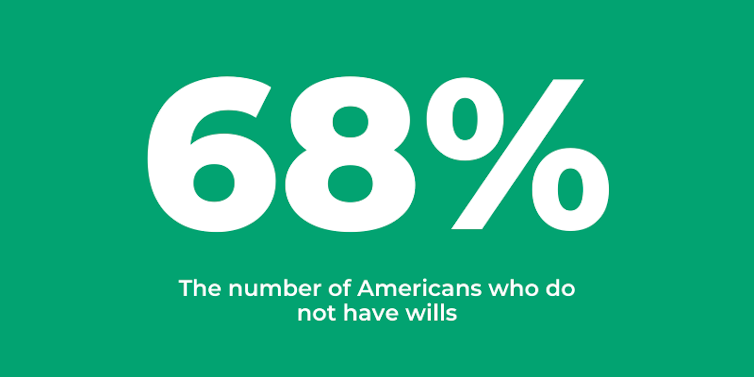
But according to one recent survey, 68% of Americans do not have a will.
We are law professors who teach and research trusts and estates. We recently studied some of the estate planning impacts of the coronavirus and concluded that, in many states, the law is not prepared to address the sudden spike in demand for self-made wills.
Dying without a will
The downsides of dying “intestate” – without a will – are well documented. Intestacy laws generally distribute property at death to the surviving spouse or descendants, a plan that is not necessarily suitable for unmarried couples and other nontraditional families.
To avoid intestacy, people may create a will by complying with the requirements of the “Wills Act,” law dating back to an English statute from 1677. A person who creates a will, called a “testator,” must sign the will or acknowledge a previously made signature in front of two witnesses who are present at the same time. Then, the witnesses also must sign the will.
Many states discourage people from writing their own wills by insisting on strict compliance with the Wills Act. For example, courts have refused to enforce documents that the testator apparently forgot to sign, instruments signed by one witness instead of two and documents signed by witnesses who only heard the testator acknowledge his signature over the telephone.
Public health crises, like the current pandemic, pose additional obstacles. Stay-at-home orders and social distancing can make it impossible to find two witnesses, especially for people who are living alone.
Judges have historically required witnesses to be physically present for the testator’s signature, so traditional law regards videoconferencing methods as nonstarters.
Wills in the time of coronavirus
Some American jurisdictions, however, have relaxed these formalities.
About half the states – including California, New Jersey, Pennsylvania, Texas and Virginia – allow testators to make holographic wills without witnesses. Instead, holographs must be entirely in the testator’s handwriting and signed by the testator. However, empirical research shows that handwritten wills are disputed in court more frequently than formal wills drafted by an attorney.
Additionally, 11 states have adopted a reform known as harmless error. This rule allows a judge to enforce a writing that does not comply with the Wills Act if there is strong evidence that the testator intended it to be his or her will.
This safety valve reassures testators who lack access to professional advice that a minor misstep will not doom their estate planning efforts. Empirical evidence suggests that the rule is not a major source of conflict or litigation.
However, because formal wills remain the only option in about half of the states, lawmakers have responded to the current pandemic by issuing emergency orders to permit remote witnessing by video communication.
These orders implement ideas from the Uniform Electronic Wills Act, model legislation introduced in 2019 but not yet adopted by any state. One of COVID-19’s lasting legacies might be bringing the law of wills into the 21st century, as states gain experience with electronic wills and ultimately enact permanent laws to permit them after the pandemic.