
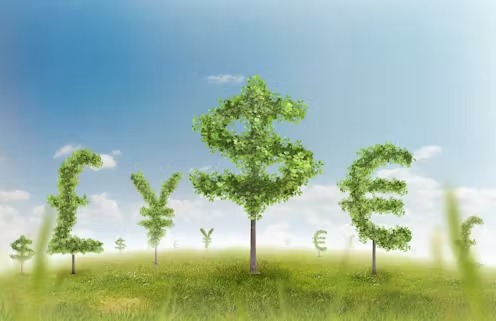
To combat climate change and help nature to recover, a lot more investment is urgently needed. The UN’s State of Finance for Nature report claims that if the world is to meet climate, biodiversity and land degradation targets, it needs to invest an extra US$4.1 trillion (£3.2 trillion) by 2050.
With most of the existing funding coming from public sources (US$133 billion), calls to close the “investment gap” are now focusing heavily on private investments, commonly referred to as green finance. Such is the power of this narrative that the need to involve corporate investors has come to be seen by many as self-evidently true.
There are a great deal of initiatives looking to provide or secure private investments to restore nature, for example through carbon and biodiversity markets. But a major risk is being overlooked: when we put a price on something given to us by nature, this fundamentally changes how we relate to it.
The entire global economy is already based on this commodification of nature. Food and fuel, for example, have been bought and sold for millennia. But now we are expanding the frontier to previously non-traded constituents of the natural world, such as carbon or biodiversity itself.
This process can change our relationship to those aspects of nature. For instance, while we may have once felt we had a moral obligation to save a certain species or habitat, once that form of nature is commodified, our motivations may switch to “conservation because it makes a profit”. The UN secretary general, António Guterres, articulated this worldview at the launch of a State of Finance for Nature report in 2021, when he said that: “By taking profits of nature-based solutions, we can vastly improve human well-being and prosperity”.

There’s carbon in them thar bogs. Joe Dunckley / shutterstock
All this heightens the risk of increased inequality. For instance, as most of the world’s land is owned by only a few people, those people will be at advantage when it comes to selling carbon credits (by planting trees or protecting peat bogs on their land, for instance). This concentrates the ability to make money out of carbon in the same hands. (This is similar to large property owners being able to charge rents and accumulate more wealth).
The idea that nature is something that can be bought and sold in a market was originally a western concept, but has now spread across the world. As market thinking is extended further into the natural world, those remaining non-western frameworks risk being further marginalised. The “Mother Earth law” in Bolivia, for instance, enshrines in law the idea that people take care of nature because it is like taking care of family. Ideas like this are not particularly compatible with a world in which forests are protected and species are saved because there is money to be made doing so.
Despite evidence of the risks of nature commodification, alarmingly little attention is being paid to it in the newly supercharged advocacy for green finance, which has a feeling of a new gold rush.
Implicit narrative in favour of commodification
The UK is a good example of how a push for private finance to fix the climate and biodiversity crises means the problems of nature commodification are ignored. In 2023, the then government set a target to stimulate £500 million per year of private investment into nature recovery, aiming to increase it to £1 billion per year by 2030 (there are no signs yet that the Labour government, elected in 2024, will change this strategy).
But when we analysed 19 policy and advisory documents that form this green finance strategy, we found they overwhelmingly think of risks in terms of how they affect investors or the market. There is lots of talk of uncertainty around financial returns, or the chances of losing consumer confidence due to “greenwashing”. Just one document, a discussion of “natural capital”, provides specific examples of ethical and cultural threats for rural communities.
Overall, there seems to be an implicit narrative in favour of commodification. Critically, it is not that the risks are unknown, but the framing remains decidedly commercial, centring the potential challenges for consumers and investors, and not in our relationship with nature. Meanwhile, red flags are already flying, as more stories emerge of market-based “carbon offsetting” policies that benefit big landowners and can end up widening rural inequalities and preventing local communities from accessing the income generated by wind farms, forests or peat bogs.
Those with a vested interest in making profits from nature may underplay the issues with commodification. And those same issues might be inadvertently ignored by people who are strongly committed to nature recovery but frustrated with slow progress. However, if we fail to engage with the way that private green finance fundamentally changes how we relate to nature, we might make things worse.
This is not to discount the possibility of ethical initiatives to invest in nature, but simply applying “good standards” will not be sufficient. We need a deep collective reflection on whether this is what we really want as a society and if so, how we effectively prevent and mitigate those risks.


