The ozone layer is on track to heal within four decades, according to a recent UN report, but this progress could be undone by an upsurge in rocket launches expected during the same period.
The ozone layer protects life on Earth from the sun’s harmful ultraviolet (UV) rays. Destruction of the ozone layer became a major international issue in 1985 when the “ozone hole” was discovered over Antarctica.
Thanks to a coordinated global effort, the Montreal Protocol came into effect in 1987, leading to a ban on a class of chemicals called chlorofluorocarbons (CFCs), which were used in aerosols and refrigeration. A global crisis was avoided as a result.
But the global space industry is growing rapidly, with an increasing number of annual rocket launches. As we show in our new review, the gases and particulates rockets emit as they punch through the atmosphere could lead to delays in the ozone layer’s recovery.
Rocket fuel emissions are not regulated
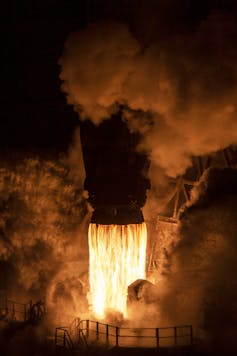
Atmospheric emissions from rocket fuels are not regulated. Official SpaceX Images/Flickr, CC BY-SA
The launch industry today relies on four major fuel types for rocket propulsion: liquid kerosene, cryogenic, hypergolic and solid. The combustion of these fuels means contemporary rockets create a suite of gaseous and particulate exhaust products, including carbon dioxide, water vapour, black carbon, alumina, reactive chloride and nitrogen oxides. These products are known to destroy ozone.
In the stratosphere, an upper level of the atmosphere where the protective ozone layer resides, emissions linger for much longer than lower down. Small amounts of an exhaust byproduct can have greater destructive effects in the upper atmosphere than when close to Earth’s surface.
A new fuel is methane, which is used in multiple rocket engines under development by major launch companies. The emissions products of methane are as yet poorly understood.
As we outline, rocket emissions in the upper atmosphere can affect the ozone layer but are not regulated. We argue this policy gap must be filled to ensure sustainable growth of the rocket launch industry and protection of the ozone layer.
Charismatic technology
Solid rocket fuel contains a chemical that releases chlorine in the upper atmosphere and destroys ozone. CFCs were banned because they contain chlorine.
Fortunately, the number of launches to date is so small that the impacts on the ozone layer are currently insignificant. However, over coming decades the launch industry is set to expand considerably. Financial estimates indicate the global space industry could grow to US$3.7 trillion by 2040.
Rockets have exciting potential to enable industrial-level access to near-Earth space and exploration throughout the solar system. This makes them “charismatic technology” – and the promise of what the technology can enable drives deep emotional investment.
The allure of possibility can get in the way of even discussing how to make rockets achieve these aspirational goals without damage. We have to be able to have clear discussions.
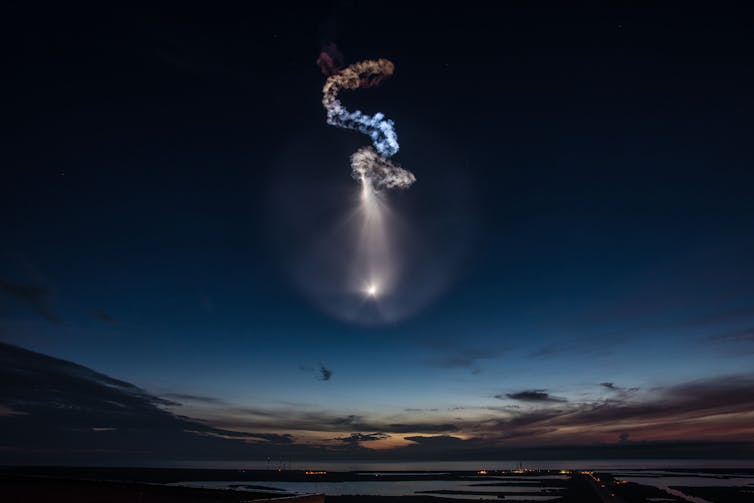
Rockets hold an exciting promise of space exploration. Official SpaceX Images/Flickr, CC BY-SA
Collecting and sharing data
Many communities – rocket launch providers, environmental regulators, atmospheric research scientists and government agencies – need to move forward together on an international level. Discussions on how to build best-practice operations for sustainability needn’t be stifling for space industry growth as potential actions are well within reach.
The greatest contribution each community can make, first off, is the collection and sharing of data. For example, those who build and launch rockets could estimate emissions during their design work and then measure actual emissions for their launch vehicles.
Working with researchers to sample emission plumes in the atmosphere would help develop understanding of the real-world impacts of emissions on the ozone layer. The current lack of these measurements for modern launch vehicles limits the predictive power of atmospheric modelling. Making data easily accessible to researchers is necessary for meaningful progress.
To evaluate emissions at early stages of rocket development, we also need accurate models of the impact emissions have on the atmosphere. This is where coordination between the space industry and the ozone research community is essential – each community holds a complementary puzzle piece, both of which together inform regulatory discussion.
Creating sustainable global rocket launches is going to need coordination across aerospace companies, scientists and governments: it is achievable, but we need to start now. This is our chance to get ahead of the game.