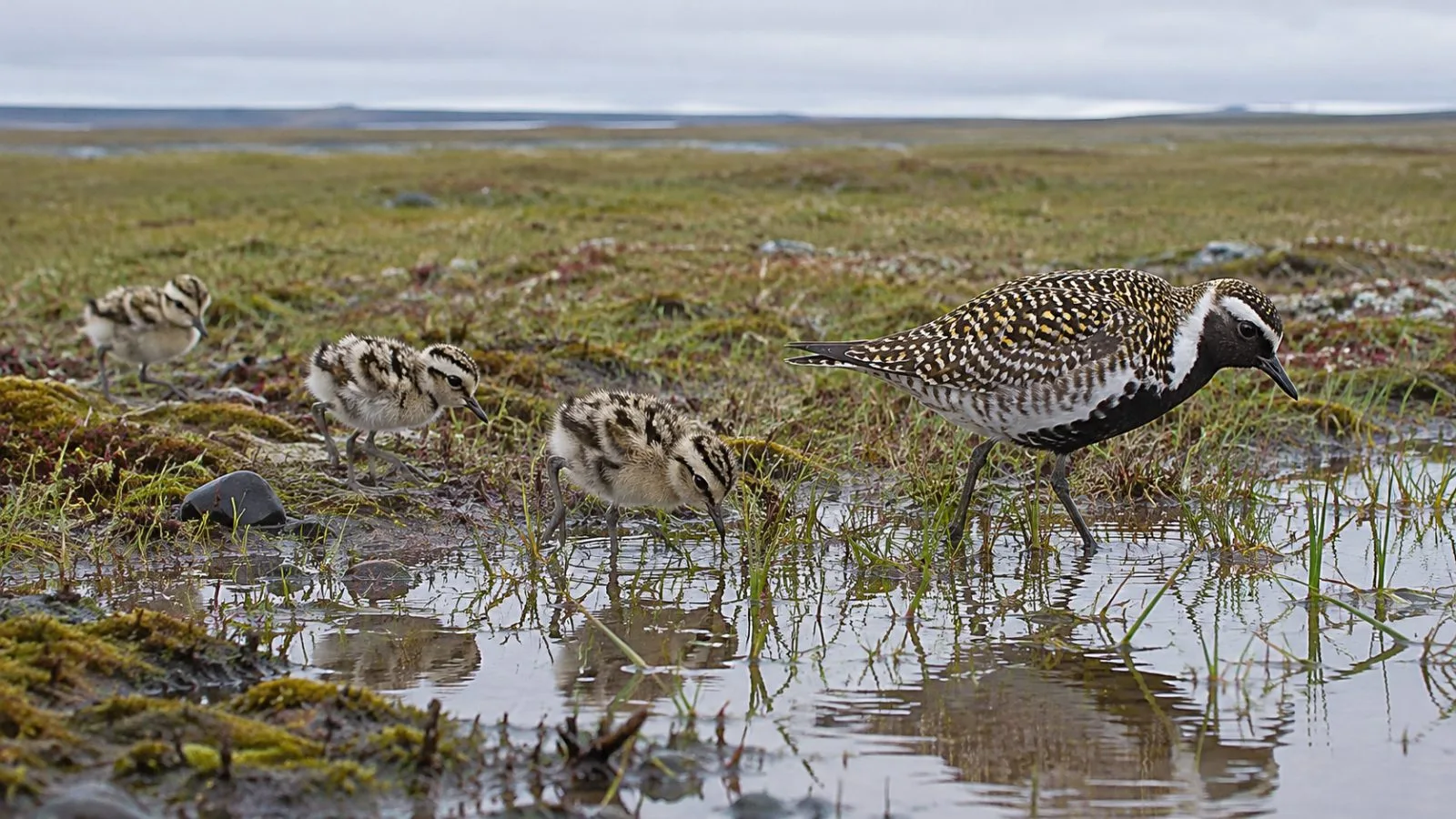
Studies near Utqiaġvik, Alaska, show that spring thaw can move invertebrate activity earlier than shorebird chick hatching, raising a food-timing concern for birds breeding during the Arctic’s short summer.
A seven-year record from 2010–2016 showed that yearly insect emergence peaks fell between June 24 and July 22. Peak hatching dates spanned July 2 to July 14. The relationship shifted with snowmelt: in early-melt years, chicks generally hatched after insects peaked; when melt came later, hatching tended to come first. Researchers detected no statistically significant association between the size of the timing gap and average invertebrate biomass available to young broods (p > 0.05).
From 2015 to 2018, researchers studied 2,239 nests representing 13 species across three sites in Arctic Alaska. In early springs, invertebrate food appeared sooner, lengthening the interval before chicks hatched. Researchers also observed behavioral flexibility and differences among sites, but said they could not determine whether birds would adjust quickly enough as conditions changed.
The climate context comes from the National Oceanic and Atmospheric Administration’s (NOAA) 2026 Arctic assessment, which found annual surface air temperatures north of 60°N rose roughly three times faster than the global average from 1979 to 2025. The studies document changes in timing but do not establish that climate change caused them.
A 2026 survey of the Arctic National Wildlife Refuge’s Coastal Plain estimated shorebird abundance was 17% lower in 2019–2022 than in 2002–2004. The 90% confidence interval spanned a 34% decline to a 3% increase. Dunlin, Long-billed Dowitcher, Red-necked Phalarope and Red Phalarope had negative trends whose 90% confidence intervals did not include zero; the Pectoral Sandpiper showed a significant increase. The survey documents regional trends, not their cause.
The migration links these Arctic breeding grounds with stopovers across the Americas. A 2023 report by the Shorebird Science & Conservation Collective for Minnesota’s Board of Water and Soil Resources estimated that two pectoral sandpipers tracked in 2018 traveled one-way routes of 8,700 and 8,900 miles from Alaska toward Argentina. A similar return journey would bring annual travel to about 17,000 miles, but the report did not measure complete round trips. It inferred one bird’s Argentine wintering location after its tag stopped transmitting shortly after arrival.