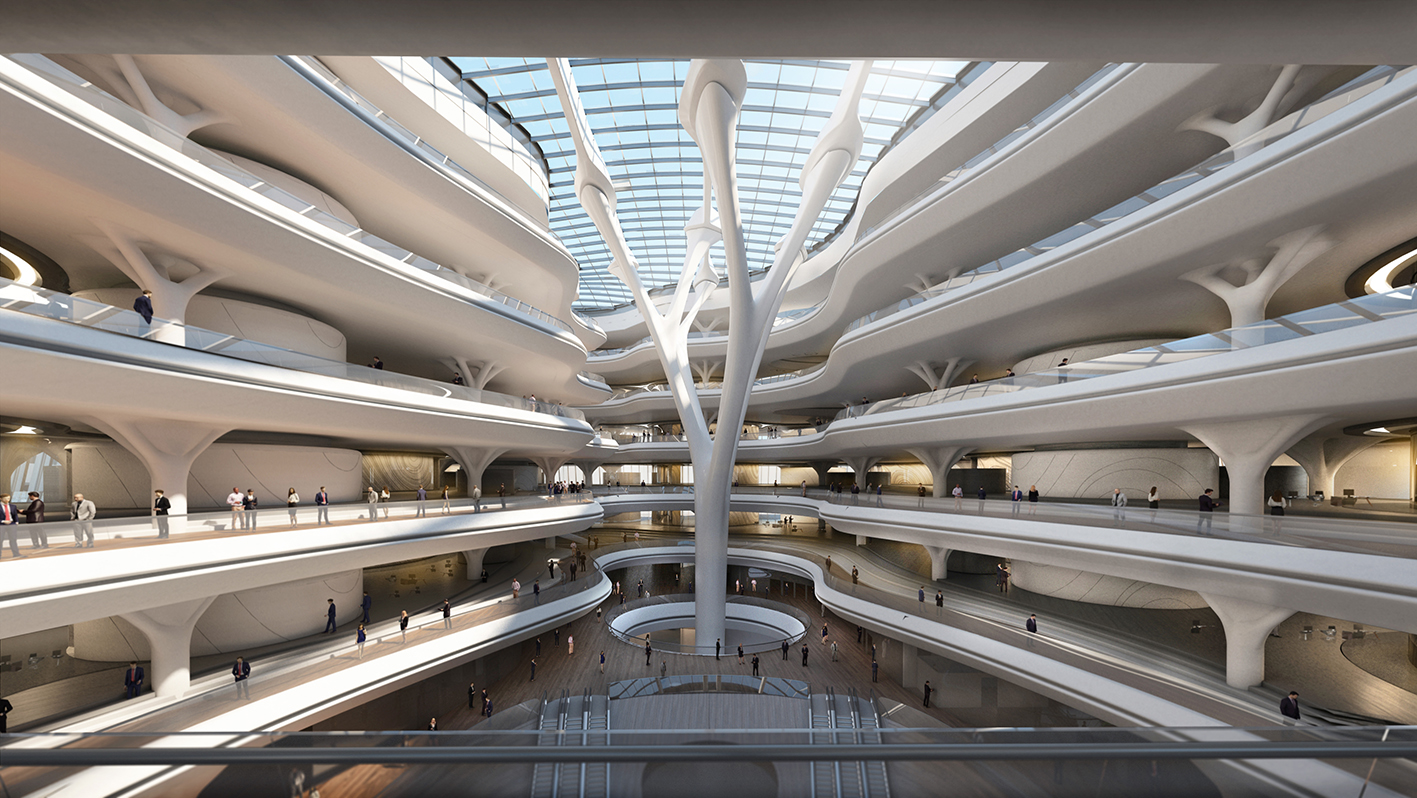
When giant blobs began appearing on city skylines around the world in the late 1980s and 1990s, it marked not an alien invasion but the impact of computers on the practice of building design.
Thanks to computer-aided design (CAD), architects were able to experiment with new organic forms, free from the restraints of slide rules and protractors. The result was famous curvy buildings such as Frank Gehry’s Guggenheim Museum in Bilbao and Future Systems’ Selfridges Department Store in Birmingham.
Today, computers are poised to change buildings once again, this time with algorithms that can inform, refine and even create new designs. Even weirder shapes are just the start: algorithms can now work out the best ways to lay out rooms, construct the buildings and even change them over time to meet users’ needs. In this way, algorithms are giving architects a whole new toolbox with which to realise and improve their ideas.
At a basic level, algorithms can be a powerful tool for providing exhaustive information for the design, construction and use of a building. Building information modelling uses comprehensive software to standardise and share data from across architecture, engineering and construction that used to be held separately. This means everyone involved in a building’s genesis, from clients to contractors, can work together on the same 3D model seamlessly.
More recently, new tools have begun to combine this kind of information with algorithms to automate and optimise aspects of the building process. This ranges from interpreting regulations and providing calculations for structural evaluations to making procurement more precise.
Algorithmic design
But algorithms can also help with the design stage, helping architects to understand how a building will be used by revealing hidden patterns in existing and proposed constructions. These can be spatial and geometrical characteristics such as the ratio of public to private areas or the natural airflow of a building. They can be patterns of use showing which rooms are used most and least often.
Or they can be visual and physical connections that show what people can and can’t see from each point of a building and enable us to predict the flow of people around it. This is particularly relevant when designing the entrances of public buildings so we can place services and escape routes in the best position.
Algorithms can also be used to extend the capability of designers to think about and generate shapes and arrangements that might not otherwise be possible. Instead of personally drawing floor plans according to their intuition and taste, architects using algorithmic design input the rules and parameters and allow the computer to produce the shape of the building. These algorithms are often inspired by ideas from nature, such as evolution or fractals (shapes that repeat themselves at ever smaller scales).
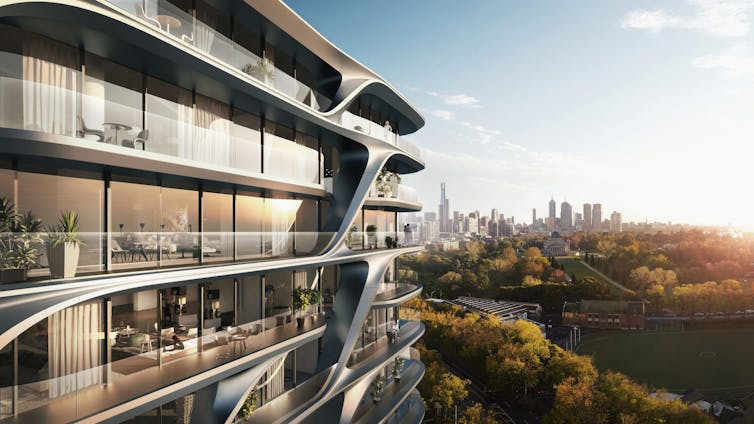
Zaha Hadid Architects has become well known for its use of algorithmic design. Zaha Hadid Architects
Combining these three uses (managing complex information, revealing patterns and generating new spatial arrangements) represents the next generation of algorithmic design that will really change our ability to improve the built environment. For example, Zaha Hadid Architects, already known for its unusual curvy constructions, uses algorithms to automatically test thousands of internal layout options or find an arrangement of facade panels that will prevent an irregularly shaped building from being prohibitively expensive.
Algorithms are also essential to novel constructions, such as the Filament Pavilion at the V&A museum, and adapted over time in response to structural, environmental and visitor usage data. Today, algorithms are even producing office arrangements for the COVID-19 pandemic that enable the highest number of employees to work in a building while safely socially distancing.
Self-organising layouts
My colleagues and I recently showed how algorithms could create a self-organising floorplan for a care home, laying out the rooms in the best configuration to improve the experience of dementia patients. To do this we combined three types of algorithm, inspired respectively by ant colonies, artificial intelligence systems based on the brain, and crowd modelling.
We built our algorithms to follow design criteria based on numerous previous studies and projects, condensing them into four main rules for the algorithms to follow. The building had to be divided into units of maximum given sizes. And each unit had to have an accessible functional kitchen, a dining room not used for other activities, and multiple lounges or activity rooms of a variety of sizes.
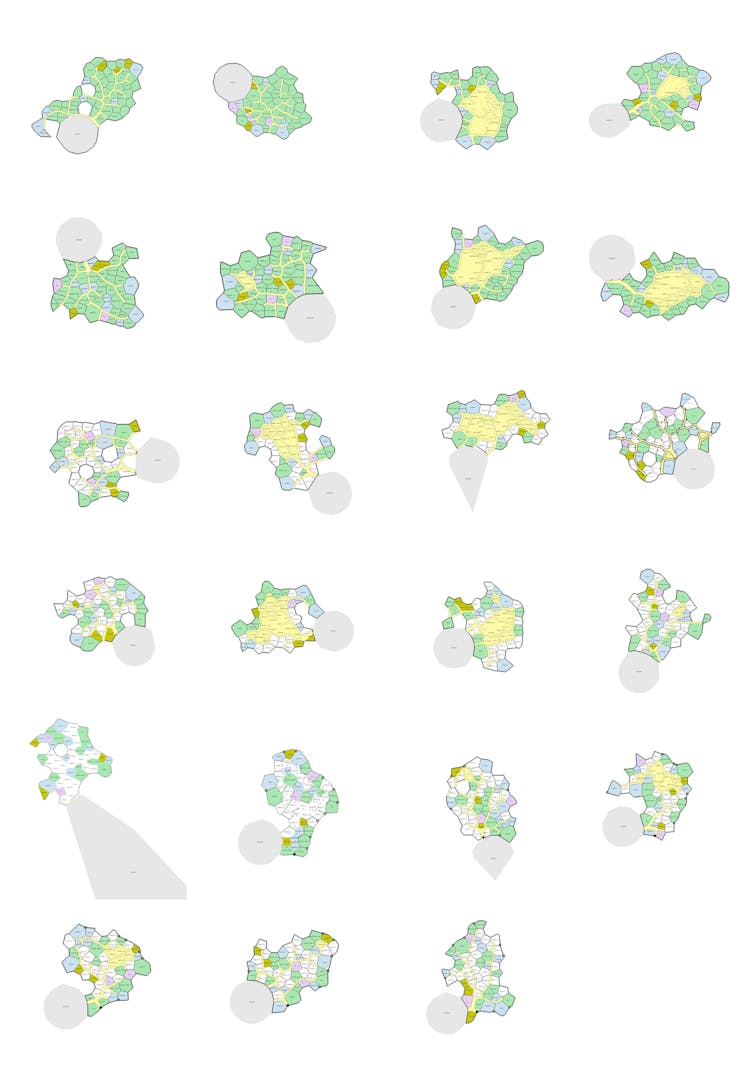
Care home layouts proposed by algorithm. Silvio Carta, Tommaso Turchi, Stephanie St Loe and Joel Simon, Author provided
The result was a new layout for a care home that arranged private rooms and common areas in the most convenient way to make residents’ journeys around the home as short as possible. This shows how the right combination algorithms and, crucially, input from designers can help produce self-organising designs that would otherwise require a huge amount of laborious work or that might otherwise not be possible.
Rather than replacing architects, as some have pessimistically predicted, algorithms are becoming an important tool for building designers. This is reflected in the technology’s growing prominence in postgraduate courses, research centres and international firms. More and more we see designers investing in the use of machine learning and artificial intelligence in architecture.
As advancements in computer science and technology are growing exponentially, it is difficult to imagine now how algorithmic design will evolve in the future and how the building industry will change. But we can certainly predict that we the use of algorithms will soon be a standard way of augmenting our ability to see the invisible and design the unthought in our buildings.
Silvio Carta ne travaille pas, ne conseille pas, ne possède pas de parts, ne reçoit pas de fonds d'une organisation qui pourrait tirer profit de cet article, et n'a déclaré aucune autre affiliation que son poste universitaire.