


 Trump Defends Russian Diesel Deal Amid US Sanctions Backlash
  BOJ Signals Faster Rate Hikes as Inflation Risks Grow
  Nasdaq Falls as Oil Prices Surge Ahead of Bank Earnings
  Trump Demands Powell Resign Over Fed Renovation Cost Overruns
  Fed's Hammack Urges Faster Rate Hikes to Fight Inflation
  Oil Prices Fall as Russia Signals Higher Diesel Exports
  ECB May Stop Rate Hikes After December, Capital Economics Says
  RBI Uses $10 Billion Currency Swaps to Drain Excess Rupee Liquidity
  FxWirePro: Daily Commodity Tracker - 21st March, 2022
  Bank of America Predicts Yen Rebound as USD/JPY Faces Risks
  RBA Says ASX Still Falls Short on Governance and Risk Controls
  Asian Stocks Plunge as AI Chip Selloff Hits South Korea and Japan


 Add as a preferred source on Google
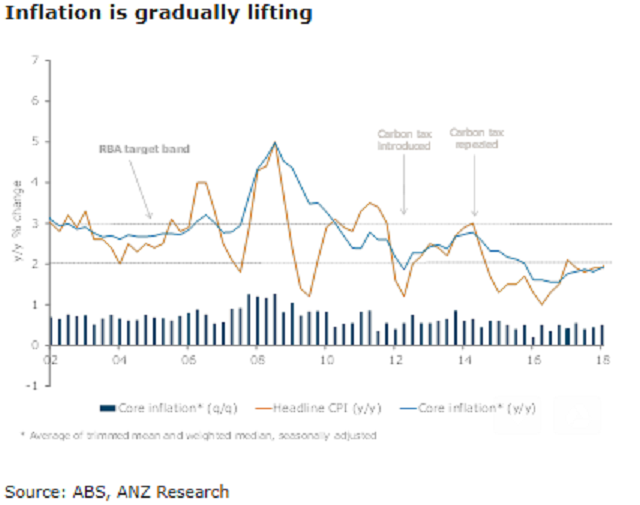
The Australian dollar has recovered against its U.S. counterpart during early European session Tuesday after having suffered a 4-month low, on the back of a weaker-than-expected consumer price inflation data (CPI) for the first quarter of this year, released early today.
The Aussie currency’s strength is further determined by fresh demand across all bourses as most cities in the East Coast continued to witness annual inflation above the 2 percent benchmark set by the central bank, wooing to solid gains in the food and housing sector.
Australia’s headline CPI rose by 0.4 percent q/q, missing market expectations of 0.5 percent q/q and down from 0.6 percent q/q in the last quarter of 2017. Further, both the trimmed mean and weighted median rose by 0.5 percent q/q. On an annual basis, both headline and core measures were stable, but still just below the RBA’s target band.
Tradable prices fell by 0.4 percent q/q in Q1, while non-tradable prices rose by 0.8 percent q/q. However, there are no signs of retail price deflation easing. Retail prices ex fruit & vegetables and alcohol fell by 0.4 percent q/q to be 3.6 percent y/y lower over the year. Given this, the onus remains on an acceleration in wage growth to lift domestic inflationary pressures.
Further, the Q1 inflation data will support the case that monetary policy will remain on hold for some time and we foresee the cash rate to remain steady at 1.5 percent until May 2019.
"Our preliminary CPI forecast for Q2 2018 is for headline inflation to rise by 0.5 percent q/q, with core inflation also rising by 0.5 percent q/q," ANZ Research commented in its latest report.
However, as of 07:35GMT, the AUD/USD currency pair was again seen trading slightly on the downside, at 0.7599, in red by 0.03 percent.
Lastly, FxWirePro has launched Absolute Return Managed Program. For more details, visit http://www.fxwirepro.com/invest







