


 Asian Currencies Steady as Dollar Eyes Fourth Weekly Gain
  US, EU Push for Action Against Asia’s Excess Factory Capacity
  Trump Secures Russian Diesel Deal as US Fuel Prices Surge
  Trump Calls for Zelenskyy Replacement Amid Russian Diesel Deal
  Oil Prices Rise as Hormuz Risks Offset IEA Stock Release
  Gold Prices Fall as Fed Signals Another Rate Hike
  France to Release 10 Million Barrels of Diesel to Ease Fuel Prices


 Add as a preferred source on Google
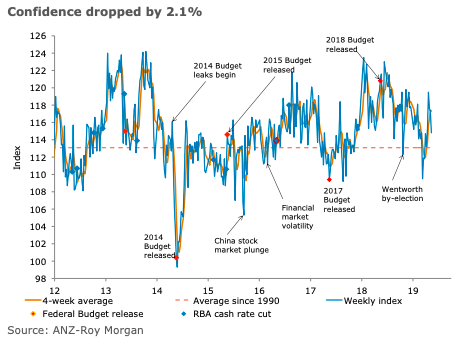
Australia’s ANZ-Roy Morgan consumer confidence fell by 2.1 percent last week, closing below its four-week moving average but remaining above the long-term average.
Financial conditions were not the cause of the fall, with current finances up 2 percent, while future finances rose 1.4 percent.
Economic conditions dropped sharply, however, with current economic conditions down a massive 8.1 percent, continuing their recent volatile pattern, and future economic conditions falling 3.3 percent.
The 'time to buy a household item' also did not help, falling 2.5 percent. The four-week moving average for inflation expectations rose by 0.2ppt to 4.2 percent.
"The fall in consumer sentiment follows a couple of important developments. Domestically the RBA decided to leave interest rates unchanged after considerable speculation that a rate cut might occur. Globally, the US-China trade dispute resumed with the US increasing tariffs on a wide range of goods. At this stage, consumers see these events as more damaging for overall economic prospects than their own finances. After a period of weakness, inflation expectations jumped to 4.5 percent for the week, pushing the four week moving average to 4.2 percent – its highest level since the end of January. The uptrend in petrol prices over the last few weeks may have supported inflation expectations," said David Plank, ANZ’s Head of Australian Economics.







