
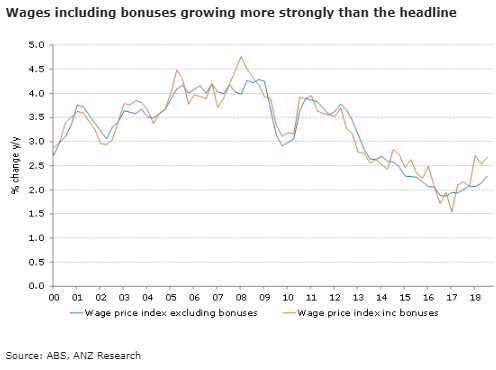
Australia’s wage price index for the third quarter of this year rose to its highest in three years, while the AUD/USD currency traded range-bound at the time of writing during Asian session Tuesday. Further inroads into unemployment and underemployment are necessary preconditions for a more meaningful uplift in wages, according to the latest report from ANZ Research.
The wage price index (WPI) rose by 0.6 percent q/q and 2.3 percent y/y in Q3, in line with market expectations but a bit softer than we expected, given the recent increase to the minimum wage. Public and private sector wage growth both rounded to 0.6 percent q/q, but in annual terms public sector wages pulled ahead to 2.5 percent y/y versus 2.1 percent y/y for the private sector.
Across industries, miners continue to experience the (equal) weakest wage growth at 1.8 percent y/y, although this accelerated from the previous quarter (1.3 percent y/y). Retail wages were also only up 1.8 percent y/y, though this was also an acceleration (from 1.5 percent y/y).
Wage growth accelerated in most sectors, with construction the only one to show a (modest) slowdown. Wages are growing fastest in health (2.8 percent y/y), education (2.7 percent y/y) and utilities (2.7 percent y/y) and are slowest in mining and retail (1.8 percent y/y), rental & real estate (1.9 percent y/y) and construction (1.9 percent y/y).
Across the states, wages in Western Australia (+1.6 percent y/y) and the Northern Territory (+1.7 percent y/y) remain the weakest, though they are picking up. Tasmanian workers are still enjoying stronger wage rises than their mainland counterparts (+2.6 percent y/y), with especially solid growth in private sector wages (+2.8 percent y/y).
Meanwhile, public sector employees in Victoria continue to enjoy the strongest wage gains (+3.3 percent y/y). At the time of writing, AUD/USD traded 0.03 percent lower at 0.7216.

