


 Tencent Shares Fall as $5 Billion AI Bond Sale Weighed
  Apple Cuts iPhone 18 Pro Production Orders Amid Weak Demand
  Zcash Plans Quantum-Resistant Security Upgrade for January
  OpenAI Revenue Hits $50 Billion, Below Earlier $70 Billion Estimate
  Moscow Exchange to Launch Crypto Trading on December 1
  David Schwartz to Reveal XRP Ledger Future at Ripple Swell 2026
  MSTR Stock Rises as Barclays Raises Price Target to $175
  Morgan Stanley Raises Coinbase Stock Price Target to $258 Ahead of Earnings
  Amazon Cuts More Jobs as AI Investment Expands
  Ripple Chairman Chris Larsen Donates $22.5 Million Ahead of US Midterms
  Oracle Uses Trucked Natural Gas to Power AI Data Centers Amid Pipeline Delays
  DWF Labs Sues BitGo for $114 Million Over Alleged Token Sales Breach
  Starbucks Explores Chipotle Acquisition as Shares Swing
  Rising Rates Top Global Growth Risks as Wealthy Investors Favor Asia
  OpenAI Annualized Revenue Hits $50 Billion, Below Earlier Estimates
  Apple Names Steve Smith M&A Chief in Leadership Shakeup
  Blockchain.com Seeks CFTC Approval for Prediction Markets and Crypto Derivatives


 Add as a preferred source on Google




Metro Bank positioned itself as “a fresh start to banking” when it launched in the wake of the 2008 global financial crisis. It was set up in 2010 as a challenger to the “big five” banks dominating the UK market post-crisis: HSBC, NatWest, Lloyds, Barclays and Santander.
But more recently, Metro Bank has caused concern among its investors for not meeting regulatory requirements on its capital levels. These rules dictate the amount of capital the bank must hold based on the riskiness of its assets, so that it can still operate but also meet any customer withdrawal requests. The riskier the bank’s activities, the more capital it must have on hand.
Regulators use such rules to ensure that banks are keeping people’s money safe. Banks can also help by creating a culture that doesn’t value excessive risk-taking. Our new research shows the extent to which top executives at banks set the tone on risk-taking. The way CEOs and even CFOs talk about risk can offer insights into a bank’s likely financial stability. A more relaxed attitude could be a valuable early warning sign of potential bank distress for regulators.
Metro Bank is currently operating normally and there is no reason to think its customer deposits are in danger. It has secured new financing, and plans to open 11 more branches. But ongoing struggles with regulatory capital levels means its business model is still being questioned by analysts.
Challenger banks like Metro are often viewed as disadvantaged because they need to keep more money on hand, compared with the UK’s big five. This adds to their costs.
The UK regulator recently rejected Metro Bank’s request to reduce its capital levels, triggering the latest concerns about its stability and causing it to seek more investor funding. The bank subsequently secured this funding, calling it “a new chapter … facilitating the delivery of continued profitable growth over the coming years”.
Why the regulator won’t relax requirements
Regulators must maintain a stable financial system that can provide essential services to households and businesses in both good and bad times. Banks are at the heart of this financial system. In the 1980s and 1990s, deregulation destabilised the industry and led to the 2008 global financial crisis. Many people lost their jobs and homes as a result, while US$15 trillion (£12.2 trillion) of taxpayers’ money was spent globally to prop up the banking sector.
Banks were largely blamed for the reckless risk-taking and careless lending that caused the crisis. But regulators also failed to detect it.
Policymakers around the world introduced extensive reforms to banking and financial regulation after 2008, to protect financial stability and avoid a repeat of this economic catastrophe. This explains the current tough stance by regulators towards relaxing rules for organisations such as Metro Bank.
UK financial authorities have even recently called out UK government plans to ease financial regulations under the Edinburgh Reforms and to remove the bankers’ bonus cap, in case it encourages more risk-taking by banks.
Recent bank failures: a stark reminder
Regulators, as well as financial market participants, also remain vigilant after the unexpected failure of a number of banks earlier this year. In particular, the collapse of Silicon Valley Bank (SVB) in the US was attributed to poor risk management. It fuelled fears about global financial stability and the possibility of yet another devastating crisis.
However, regulation alone is not enough to mitigate excessively risky behaviour. The attitude to risk that runs through a bank – its risk culture – also matters.
A company’s risk culture comprises a set of values, attitudes and behaviour related to the awareness, management and control of risks. It shapes decisions about things like who to lend to, what to invest in, and how to manage the risks that arise as a result.
Most banks’ business models rely on balancing risk management with profit maximisation in this way. But it needs to be done responsibly: signs of poor risk culture, such as excessive risk taking or misconduct, are red flags to regulators and investors.
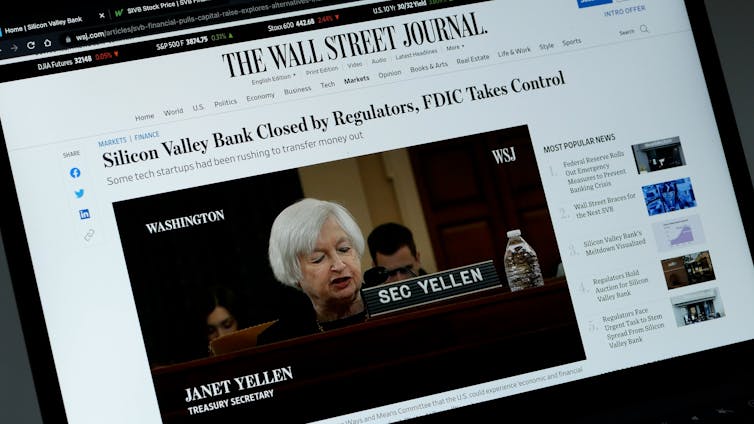
Silicon Valley Bank collapsed in March 2023, the second-largest bank failure in US history. Domenico Fornas/Shutterstock
But it’s difficult for outsiders, even regulators, to observe and measure a bank’s risk culture. So, our recent study aimed to quantify the risk culture of 160 US banks, including some of the country’s largest. We did this by analysing the text of conference calls on which their CEOs answered questions about the business from analysts, investors and the media. This allowed us to capture their unscripted views and behaviour when these bank CEOs were put on the spot.
We used a machine learning algorithm to construct a dictionary of words and phrases associated with seven different risk culture dimensions, including “risk strategy” and “regulatory requirements”. We used another algorithm to assess whether these phrases were being used in a positive or negative way.
Our analysis showed that words and phrases associated with the “regulatory requirements” risk culture dimension, for example, were mentioned the least by CEOs prior to and during the global financial crisis. Unsurprisingly, use of the term picked up in its aftermath, as CEOs had to explain how tightening banking regulations were affecting their businesses.
By calculating the number of positive and negative occurrences of each phrase, we were able to create a measure of CEO attitudes for each risk culture dimension. We found that a weaker risk culture – characterised by more negative mentions of these phrases – indicated a greater probability of bank insolvency as a result of not having enough capital.
More worryingly, we found similarities in attitudes to risk between collapsed US banks SVB and First Republic, and other US banks that are still operating today.
Our research indicates that a strong risk culture in banking starts with the right tone from the top. Executives should be aware of their role model status when making decisions and talking about risk, both within their companies and to the public. Their attitudes cascade down to every other level and, if they are serious about managing risk, this could help maintain financial stability not only of their own bank, but the financial sector as a whole.







