


 Ethereum Price Drops Below $2,600 as Long Liquidations Hit 4-Month High
  Fed’s Hammack Says Bond Yield Surge Is Not Driven by Inflation Fears
  Australia Consumer Confidence Plunges as RBA Rate Hike Hits Households
  Bitmine to Stop Ethereum Buying After Reaching 5% ETH Supply
  Bitcoin Outflows From Binance Hit Three-Year High as Whales Accumulate
  Solana User Growth Jumps 33%, Outpacing Ethereum and Chainlink
  Fed Minutes Signal Another Rate Hike by Year-End
  Strategy’s STRC Nears $100, Raising Prospects for Major Bitcoin Buys
  Kalshi Withdraws PEPE Perpetual Futures Filing
  Fairshake Backs 32 Pro-Crypto House Candidates
  Cardano Price Eyes $0.30 as ADA Whale Activity Surges
  BlackRock’s Rick Rieder Favors Bonds Over Stocks as Treasury Yields Surge
  RBA Hikes Interest Rate to 4.60% as Inflation Risks Rise


 Add as a preferred source on Google
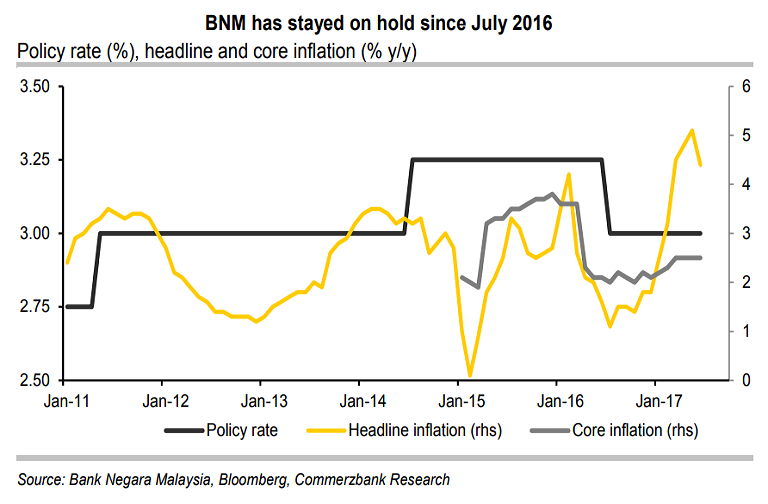
Malaysia’s central bank kept its benchmark rate unchanged today as expected. The central bank held rates unchanged at 3 percent despite higher inflation as it sees the economy maintaining steady growth and inflation spike as largely driven by the fuel price hikes. In a statement that followed, Bank Negara said at the OPR's current level, the central bank's monetary policy was accommodative and supportive of economic activity.
Regarding Economic growth: Bank Negara said the Malaysian economy performed better than expected in Q1 2017. Stronger domestic demand and additional impetus from exports propelled Malaysia's growth higher. The central bank expects the economy to register higher growth in 2017.
Malaysia's economy grew at a better-than-expected 5.6 percent year-on-year in the first quarter on robust exports and strong domestic demand. It was the quickest pace of rise in two years. Second-quarter growth data will be released on Aug. 18 and 32.5 percent surge in May exports from a year earlier raise upside risks for growth.
Regarding Inflation: Bank Negara said headline inflation is expected to moderate in the second half of the year, mainly reflecting the waning effect of global cost factors. Underlying inflation, as measured by core inflation, will be sustained by the more robust domestic demand, but is expected to remain contained, it added. BNM does not have an explicit inflation target but for 2017, it is projecting 3-4 percent.
Headline inflation has picked up steadily since the start of the year from just 2.1 percent in 2016 to average 4.3 percent y/y in the first five months of 2017. Analysts at Commerzbank believe the spike in inflation was largely driven by higher retail fuel prices following a shift in the price setting mechanism. It is expected to moderate in H2 this year but it is still expected to come in at the upper end of BNM’s projection this year, at 3.8 percent.
Regarding exchange rate: Bank Negara noted domestic financial markets had been resilient and that the ringgit had remained stable. The central bank said the ringgit remained stable due to a more balanced demand and supply of foreign currencies, following implementation of Malaysia's financial market development measures.
The MYR began to appreciate from April this year after holding above the 4.40 level in Q1 2017. MYR has gained 4.5 percent vs USD year-to-date vs the average for Asian currencies of just under 4 percent. MYR remains vulnerable to net portfolio outflows. Talk of an early general election, could also see official support for MYR. The next general election is not due until August 2018.
"If growth remains firm and core inflation begin to climb towards the 3% level e.g. due to firmer wage pressures, we could see BNM turn less accommodative. We suspect BNM is content with the current growth-inflation mix. We expect BNM to stay on hold at 3% till year-end," said Commerzbank in a report.
USD/MYR was trading at 4.2905 at around 1125 GMT. The pair has been largely range-bound since the beginning of the month, with a high of 4.3085 and a low of 1.2885. Bias remains lower and we see scope for test of next major support at monthly 20-SMA at 4.2205. FxWirePro's Hourly USD Spot Index was neutral at -25.5438 at 1140 GMT. For more details on FxWirePro's Currency Strength Index, visit http://www.fxwirepro.com/currencyindex.
FxWirePro launches Absolute Return Managed Program. For more details, visit http://www.fxwirepro.com/invest







