


 Yen in Focus as BOJ, Fed Rate Hikes Reshape Currency Markets
  Litecoin Marks 15 Years as Grayscale Backs LTC ETF Push
  BlackRock’s Rick Rieder Favors Bonds Over Stocks as Treasury Yields Surge
  Strategy’s STRC Nears $100, Raising Prospects for Major Bitcoin Buys
  RBA Hikes Interest Rate to 4.60% as Inflation Risks Rise
  Fed Unveils Stablecoin Rules Under GENIUS Act
  Zcash Mining Profits Surge as Liquidity Risks Grow
  Kazakhstan and Tether Explore Tenge Stablecoin and RWA Tokenization
  Sector Spotlight: Data Availability and Storage Lead 24-Hour Market Gains
  Bitcoin Price Falls Below $83K as Liquidations Hit $697M
  Bitcoin Outflows From Binance Hit Three-Year High as Whales Accumulate
  Australia Consumer Confidence Plunges as RBA Rate Hike Hits Households
  Robinhood Buys $25 Million in Bitcoin for Corporate Treasury
  ECB May Stop Rate Hikes After December, Capital Economics Says
  U.S. Government Moves Over $100M in Bitcoin and BNB


 Add as a preferred source on Google
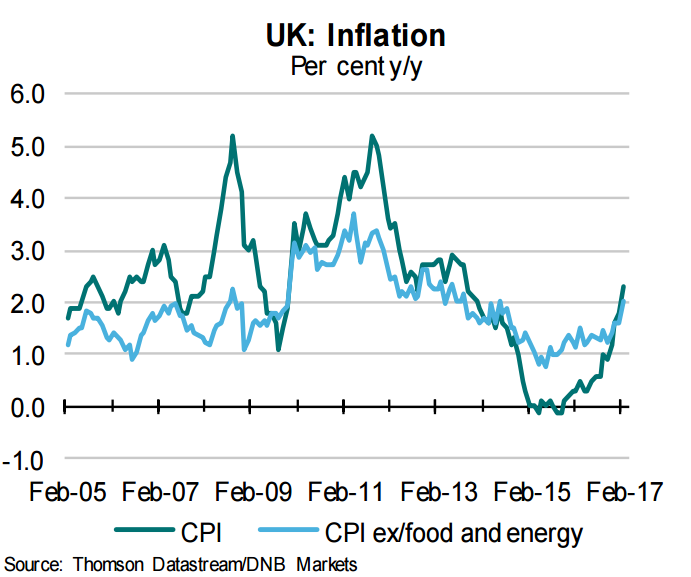
Stronger-than-expected U.K. inflation data for February will lead to speculation for a more hawkish sentiment towards BoE policy. Data released by the Office for National Statistics' showed Tuesday that UK Consumer Prices Index (CPI) spiked to 2.3 percent in February, up from 1.8 percent in January. UK inflation surged above the Bank of England’s 2.0 percent target for the first time in over three years in February.
"It remains likely that policymakers will adopt an increasingly dovish tone in coming months, despite the rise in inflation, as the economy slows due to consumers being squeezed by low pay and rising prices," said Chris Williamson Chief Business Economist, IHS Markit.
After last week’s BoE policy meeting generated slightly more hawkish noises from some MPC members, yesterday’s inflation figures provided a significant upside surprise. As in the recent months, transport costs remained the main driver of inflation due to higher oil prices and sterling depreciation. Going forward analysts expect CPI will likely rise close to 3 percent Y/Y by year-end and remain well above the BoE’s target through to 2019.
Further, as firms pass rising costs onto customers in coming months, more upward pressure on consumer prices looks almost certain. Recent PMI survey data show companies’ input costs increasing at a rate not exceeded since before the global financial crisis, due mainly to import costs surging higher as a result of the weakened pound. The same survey data indicate that average prices charged for goods and services are meanwhile rising at the fastest rate for almost six years.
But with real wage growth having already fallen below zero in January for the first time in almost 2½ years, further increases in inflation will push real income growth further into negative territory over coming months, weighing on consumption, the key driver of GDP growth over recent years. And also, concerns over the impending start of EU exit negotiations and demands from the SNP for a second independence referendum likely to keep BoE inclined towards a dovish policy bias.
"We maintain our view that the majority on the MPC will look through the period of above-target inflation and keep Bank Rate unchanged at its current level this year and probably beyond," said Daiwa Capital Markets in a report.
GBP/USD has posted an impressive recovery in recent days. The pair has bounced back to around 1.24 since hitting low of 1.21 earlier this month. On the day, the major was slightly weaker, down 0.27 percent. FxWirePro's Hourly USD Spot Index was at -41.1342 (Neutral), while Hourly GBP Spot Index was at 52.0817 (Neutral) at 1210 GMT. For more details on FxWirePro's Currency Strength Index, visit http://www.fxwirepro.com/currencyindex.







