The world is rightly shocked by the immense pain and suffering caused by the deadly attacks at Zaventem airport Brussels and on the city’s metro. But it is also important to consider that while such acts need to be condemned in the strongest possible terms, the way people respond to them can also illustrate a more positive side to human nature.
People affected by attacks such as those in Brussels often behave much better than is traditionally expected by the authorities and in popular discourse. People tend to come together en masse to respond to such incidents and support each other in the face of adversity.
The term “panic” is widely used by the media to describe crowd responses to mass terrorist attacks, and Brussels was no exception with mobile phone footage clearly showing people fleeing the Zaventem airport terminal. Yet so far there is no evidence of actions that might be associated with “panicked” behaviour – such as pushing or trampling over others to get out.
One could even say that people’s speed at fleeing the scenes of the attacks was a logical response to a credible threat. Brussels had been bracing itself for a terror attack in the wake of the November attacks in Paris, and was on a heightened state of alert following recent anti-terror raids.
Such orderly behaviour also appears to have been apparent during the attack on the Brussels metro, and mobile phone footage of passengers evacuating the Brussels metro is eerily reminiscent of images from the 2005 London bombings.
While “mass panic” is often predicted by the media after such events, it almost never happens. Many of us involved in the study and practice of emergency planning responses would like to see the term disappear from descriptions of such events. It is too loaded a term and rarely describes them accurately.
Rush to help
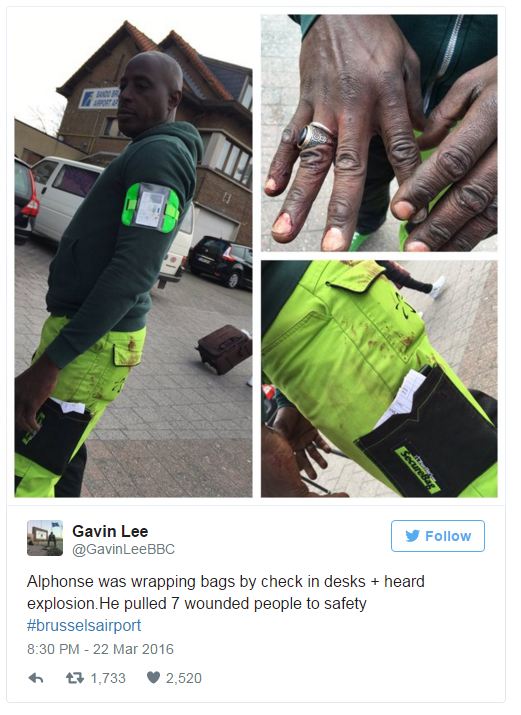
The attacks also seem to have inspired active co-operation among those affected. For instance, a BBC reporter tweeted pictures of a baggage handler who helped evacuate injured from the terminal in the aftermath of the explosion.

There have also been reports of hotel workers near to the metro station bringing out towels and sheets to help the injured as they reached the surface.
This fits with research I did with John Drury into the July 7 2005 London bombings, where we argued that such situations could bring out a positive response among those affected, as survivors and bystanders co-operated with each other before the emergency services arrived. We suggested that this was because such situations could bring people together in a shared sense of adversity (“we’re all in this together”), which would encourage co-operative behaviour.
In a blog after the inquests into the 7/7 bombing, I argued that co-operation in such situations was usually the norm, not the exception. This was because the shared identity that developed would encourage altruistic rather than selfish acts.
This isn’t to say that everybody behaves like superheroes. It’s more that the often calm (as opposed to “panicked”) nature of people in emergencies means that cooperation becomes a psychological norm. Individually selfish or anti-social behaviour is usually rejected by the crowd as a whole.
The benevolence of crowds
Drury and I have proposed a social identity model of “collective resilience” that we believe explains crowd behaviour in emergencies much better than outdated and clichéd models of “mass panic”. This has implications for emergency planning and response: crowds should be trusted more in emergencies, as they could provide valuable support and resources.
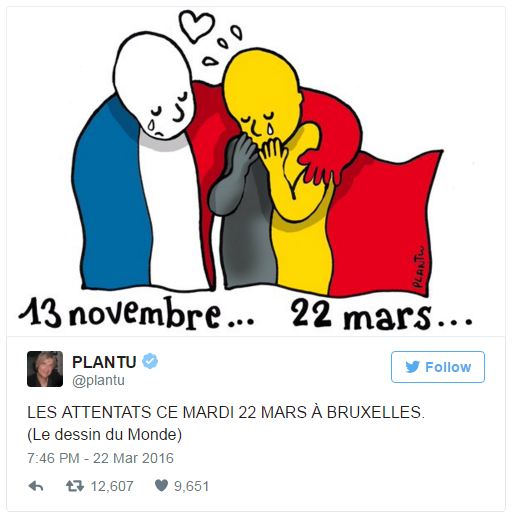
Another aspect of this shared identity in the aftermath of such horrific events, is the way that they often bring people together in a shared sense of mutual support in the days and weeks afterwards – often in global solidarity as after the Paris attacks.
Already, people online have been sharing the graphic below from Le Monde newspaper in response to the attacks in Belgium.

Far from dividing people and communities – as those behind such outrages often intend – the murderous acts of the few can often unite the majority to respond positively in their aftermath instead.
 The research into 7/7/2005 mentioned in this article was funded by an Economic and Social Research Council grant paid to John Drury as Principal Investigator and ran from 2004-7 at the University of Sussex
Chris Cocking, Researcher in Crowd Behaviour, University of Brighton
This article was originally published on The Conversation. Read the original article.