


 Best Gold Stocks to Buy Now: AABB, GOLD, GDX


 Add as a preferred source on Google
Canadian merchandise exports rose 2.3% in July 2015, helping to narrow Canada's trade deficit to $593 million, down from $811 million in the prior month. The strength in exports was both a price story (+1.3% m/m) and a demand story, with export volumes up 1.0%. Imports were also up a healthy 1.7%, but mostly on higher prices (+1.3% m/m).
The bulk of the jump in real exports was mostly driven by motor vehicle and parts (+6.5%) and aircraft and other transportation equipment (+15%). Stripping away these two sectors, real exports were flat. Statistics Canada attributed the gain in motor vehicles and parts to shorter-than-usual seasonal plant shutdowns at many auto producers in July. Industrial machinery and equipment (+4.0%) and consumer goods (+2.1%) were also bright spots in the report. While prices for Canadian energy products remained heavily depressed in July, export volumes rose 1.4%, following two monthly contractions. Real exports have now recovered all the losses from the first half of the year, and then some.
The jump in Canadian exports in July was largely driven by increased demand by China (+11.7%), while exports to the U.S. were up a more modest 2.1%. Canada's trade surplus with the U.S. sat at $3.8 billion in July, down from $4.4 billion in June. Meanwhile, Canada's trade deficit with the rest of the world narrowed to $4.4 billion in July, from $5.2 billion in June.
The July trade data revealed a second straight month of strength in Canadian exports, particularly of non-energy products. While it is still too early to be certain, the recent trade data helps support the view that Canadian non-energy exporters will benefit from a cyclical boost in the near-term. Canada's trade performance through the summer months is consistent with an estimate for real GDP growth of 2.5% annualized in Q3, underscoring the view that Canada's economic soft patch is now in the rearview mirror. This is about one percentage point above the growth expected by the Bank of Canada in its July Monetary Policy Report, suggesting the Bank will likely stay on hold for the time being.
Some of the factors boosting trade in July may prove temporary - such as the volatile nature of aircraft and other transportation equipment, the temporary boost to auto exports and the increased demand from China. However, with the Canadian dollar now at the 2-year mark since it first started to depreciate, the non-energy export sector is expected to finally get that positive boost from the currency we have anxiously been waiting for.

- News

- Economy

- Central Banks
- Investing
- Research
- Roundups
- Digital Currency
- Insights
- Technical Analysis
- Technology
- Business
- Law
- Health
- Nature
- Fintech
- Science
- Topic
- Opinions
- ©Econometrics LLC . All Rights Reserved.
Canadian trade sector helping to pull economy past soft patch
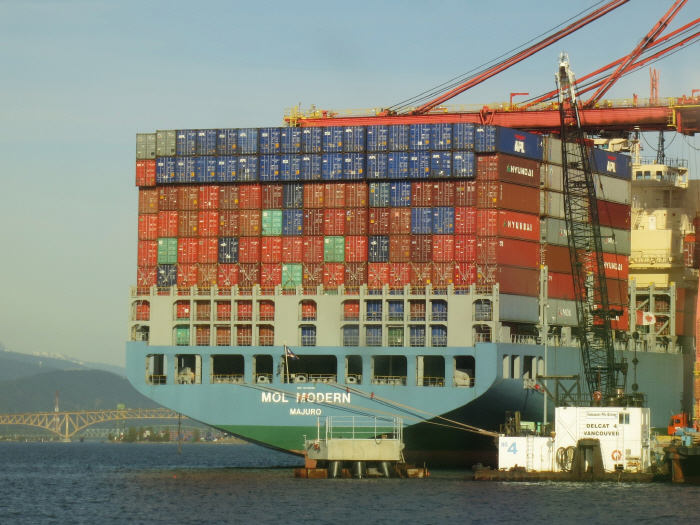
Enormous container ship (Ruth Hartnup_Flikr)
Thursday, September 3, 2015 11:18 PM UTC
Editor's Picks



- Market Data
Most Popular




