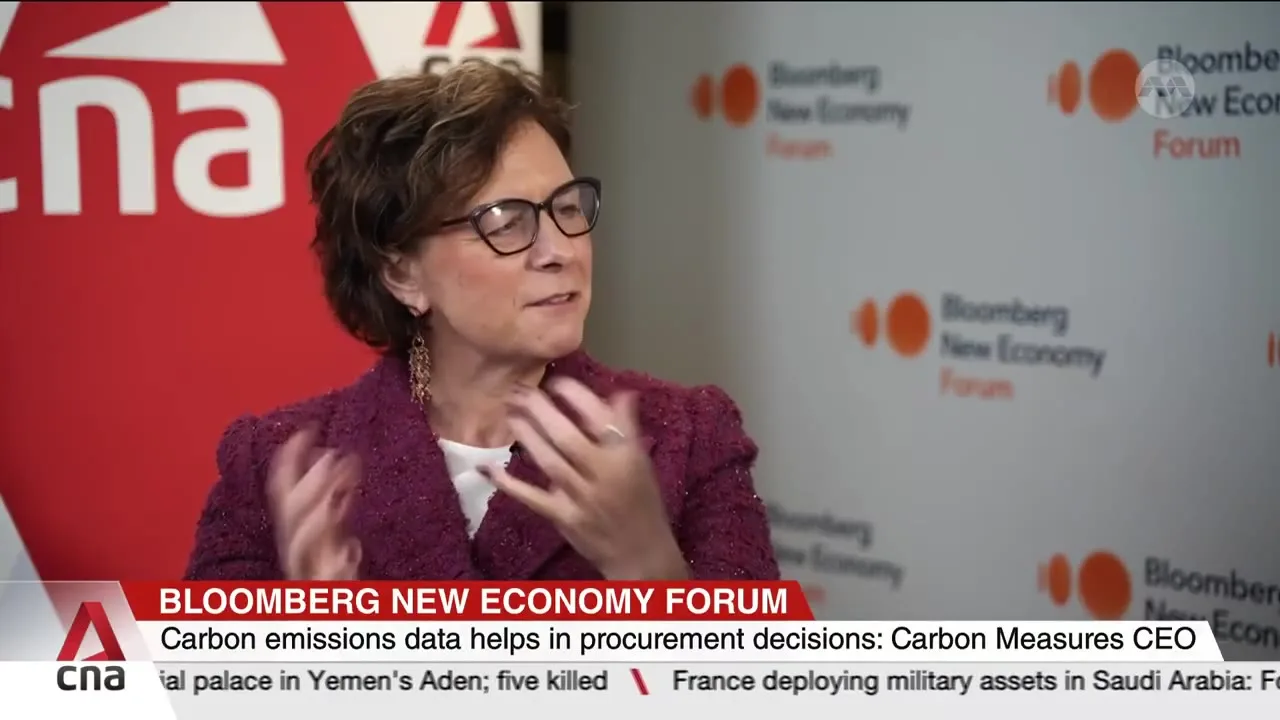
Governments should set emissions-reduction targets for products and let companies compete to meet them, the chief executive of carbon-accounting group Carbon Measures said in a CNA interview.
The approach would replace voluntary corporate commitments with policy certainty while encouraging businesses to find lower-emission ways to produce goods. Companies can retreat from voluntary pledges when leadership or business conditions change, the CEO said.
The interview was conducted at the Bloomberg New Economy Forum and published by CNA on Oct. 16. The CEO said common carbon-accounting rules would help policymakers regulate emissions and allow businesses to make greener procurement decisions.
“You can't manage what you don't measure,” the CEO said. Buyers comparing two products often cannot determine the carbon intensity of their production, limiting their ability to make informed choices.
The CEO compared the proposed system with financial accounting standards, including International Financial Reporting Standards and generally accepted accounting principles. Common rules would show how emissions calculations were made and allow consistent comparisons.
A second model was the nutritional label used on food. Consumers can compare calories, protein and sugar across products because the information follows familiar rules, the CEO said.
Heavy industrial products and other hard-to-abate sectors need comparable rules and a label showing their carbon intensity. Such information would help governments and companies compare products before setting regulations or making purchasing decisions.
For India, the CEO said policymakers should give companies targets for reducing emissions associated with their products, then allow them to innovate and compete. Renewable energy could compete with fossil fuels paired with carbon-capture technology, balancing the country's energy needs with emissions reductions.
Artificial intelligence could improve energy efficiency and management of electricity-grid loads, but its energy demand will be immense, the CEO said. Policymakers and businesses should use that demand to expand green-energy technologies and achieve economies of scale.
New data centers should run entirely on renewable energy where possible. Where that is not possible, operators should capture the carbon emitted, the CEO said.
Policies should make technologies compete on emissions as well as the speed at which they can supply electricity to data centers. The CEO called competition essential to sustaining corporate action beyond voluntary commitments.
Businesses also face systemic constraints when pursuing climate goals. Product-level targets agreed by governments and companies would give businesses greater certainty about future policy requirements, the CEO said.
For China, the United States and India, governments should coordinate climate, trade, industrial and energy-security policies rather than develop them separately. The CEO said those policies should pursue affordability, economic competitiveness and emissions reductions together.
Countries should treat the transition as a race for industrial competitiveness, the CEO said. The remarks did not specify target levels, implementation dates, enforcement mechanisms or common standards for calculating product emissions.