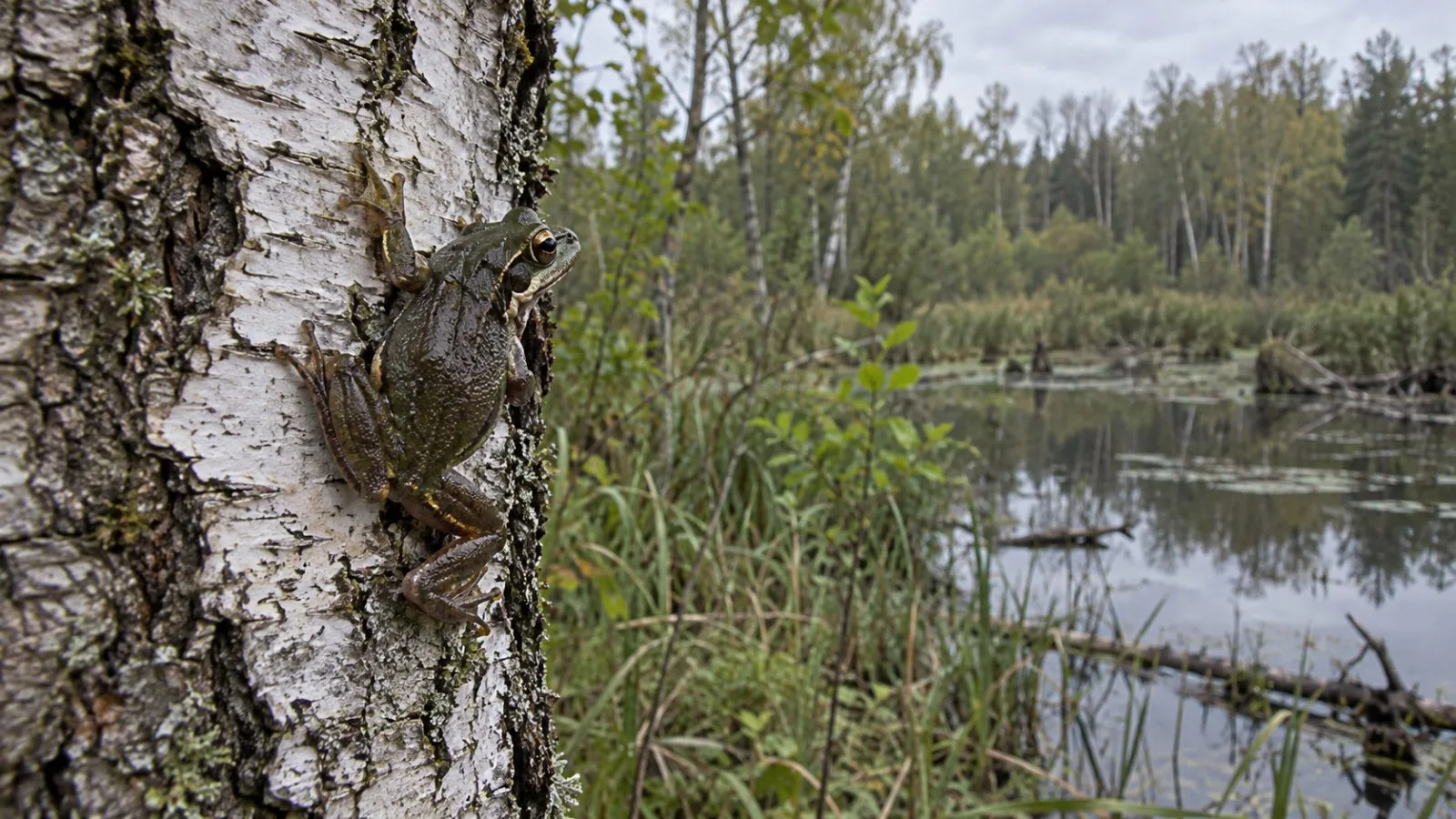
A 2022 study published in Evolutionary Applications measured dorsal skin luminance in 189 adult male Eastern tree frogs (Hyla orientalis) at 12 sites in northern Ukraine during the 2017-2019 breeding seasons. Eight sites were inside the exclusion zone and four were about 40 kilometers east; researchers sampled across roughly 2,200 square kilometers.
Frogs inside the zone averaged 43.6% lower dorsal skin-luminance readings than the comparison group. The percentage describes the luminance reading, or apparent lightness; the study did not quantify a change in melanin.
Across sites, lower readings were associated with shorter distances to areas where cesium-137 contamination exceeded 3,700 kilobecquerels per square meter in May 1986. Estimated individual absorbed-dose rates for the sampled frogs were not associated with skin luminance.
The authors said intense exposure after the accident may have favored frogs with darker skin. Because the study was observational, it could not establish that radiation caused the difference. Researchers also did not test whether pigmentation protected the frogs or improved their chances of survival.
The authors said that, to the best of their knowledge, no frog samples collected before or immediately after the accident were available for comparison. They called for follow-up research to explain the pattern and assess its evolutionary significance.
A separate 2023 study in Chemosphere examined liver tissue from 65 male frogs at five sites inside the zone. Individual absorbed-dose rates had no significant effect on the measured liver-cell features. However, liver melanomacrophage area was 72.9% higher at low-radiation sites than at medium-high radiation sites. The study found no correlation between that liver measure and dorsal skin luminance.
A 2024 study in Biology Letters examined 256 frogs over three consecutive years. It found no relationship between individual absorbed radiation and age in 197 frogs, telomere length in 62 frogs, or corticosterone levels in 54 frogs.