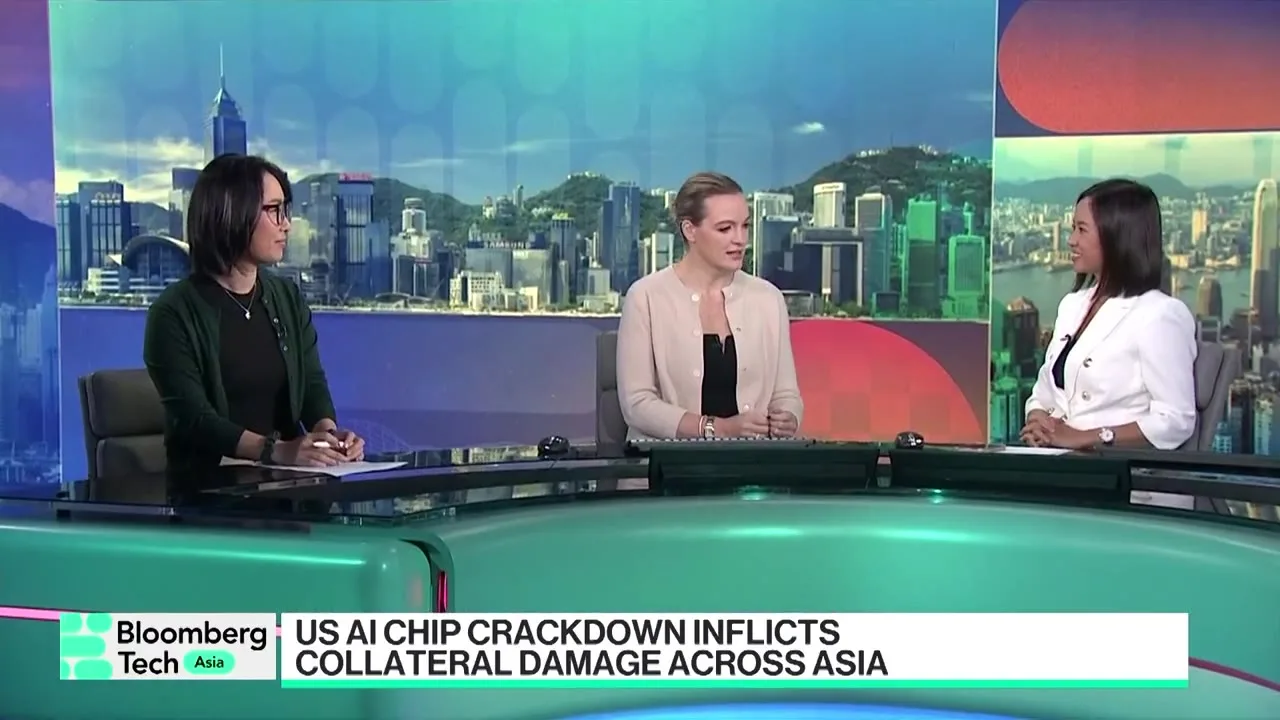
Chinese AI model development is being pushed back by U.S. chip curbs, Wei Sun, principal AI analyst at Counterpoint Research, said on Bloomberg Technology, published Nov. 27.
Tencent said this month that its next-generation AI model would be delayed and development would slow. Alibaba said cloud growth would slow over the coming year before returning to its previous pace in 2028.
Alibaba also said it would rely on chips made in China to train its next-generation model. Z.AI has delayed its next model release because of the latest restrictions, according to reporting cited on the programme.
Sun said Chinese companies were already feeling the effect of the restrictions, while data-centre projects in Southeast Asia faced questions over funding and whether they could attract customers under tighter chip-access rules.
China may respond through rare earths, which it dominates in processing, or by sanctioning companies that depend on Chinese suppliers, Sun said. He said Beijing’s extension of rare-earth restrictions before a deadline could be a goodwill gesture after U.S. President Donald Trump intervened, although it was unclear how much Trump and Chinese President Xi Jinping had discussed the issue.
The next test could come when Xi visits the United States in December. Sun said companies were watching how quickly Chinese firms could release models trained on domestic chips and how powerful those models would be compared with systems trained on Nvidia chips.
Jensen Huang, Nvidia’s chief executive, has argued that China should retain access to Nvidia chips. A U.S. senator said the AI contest with China required ensuring that the most advanced chips did not reach Chinese hands and called for more legislation to restrict exports.
Huang said in June that national security should guide technology policy, but policymakers should be specific about the risks before imposing export controls.
A researcher interviewed on Bloomberg Technology said China’s domestic AI computing capacity was split roughly equally. It comprised Chinese-made chips, chips licensed for use in China or imported before controls, and chips brought in by circumventing the rules. The estimate was uncertain, especially for smuggling.
Customs data indicated that Malaysia’s exports of servers to China rose sharply after the United States barred direct chip exports, with the increase worth several billion dollars. The equipment was almost certainly used for AI because of its high unit value.
Smuggling appeared to peak from late 2024 through early or mid-2025 before declining. It was unclear whether tighter rules caused the fall or whether smugglers became better at hiding shipments. Prices for controlled chips inside China have risen, consistent with reduced availability.
The tracker estimated that about 70% of global AI computing came from the United States and 10% from China. Chinese firms could also use overseas cloud services and techniques such as distilling U.S. models, so chip counts alone did not determine how quickly China’s AI sector would slow.
Sun said pure-play Chinese AI labs would face the hardest pressure because companies such as Z.AI and Moonshot had supplied open-source models to U.S. clients. DeepSeek could be better placed because it had focused on efficient software and hardware design and had used Huawei chips for some training and inference.
He said domestic Chinese chips could support some inference, but frontier-model training required the most advanced processors. The gap could widen as U.S. companies adopt more powerful Nvidia chips over the next two years, although Chinese companies could still expand the use of existing AI in domestic industries.