


 Australia Consumer Confidence Plunges as RBA Rate Hike Hits Households
  Yen in Focus as BOJ, Fed Rate Hikes Reshape Currency Markets
  BlackRock’s Rick Rieder Favors Bonds Over Stocks as Treasury Yields Surge
  Jay Clayton Named Trump’s AI Czar as XRP Past Resurfaces
  Bitcoin Price Falls Below $83K as Liquidations Hit $697M
  Fed Unveils Stablecoin Rules Under GENIUS Act
  Sector Spotlight: Data Availability and Storage Lead 24-Hour Market Gains
  Cardano Price Surges 10% as ADA Targets $0.30
  RBI Rate Hike Bets Surge as Inflation Rises
  Fed Minutes Signal Another Rate Hike by Year-End
  China Shuts 670 Banks as Bitcoin Eyes Financial Risks
  DogecoinVM Makes DOGE Transactions 300x Faster
  Solana User Growth Jumps 33%, Outpacing Ethereum and Chainlink


 Add as a preferred source on Google
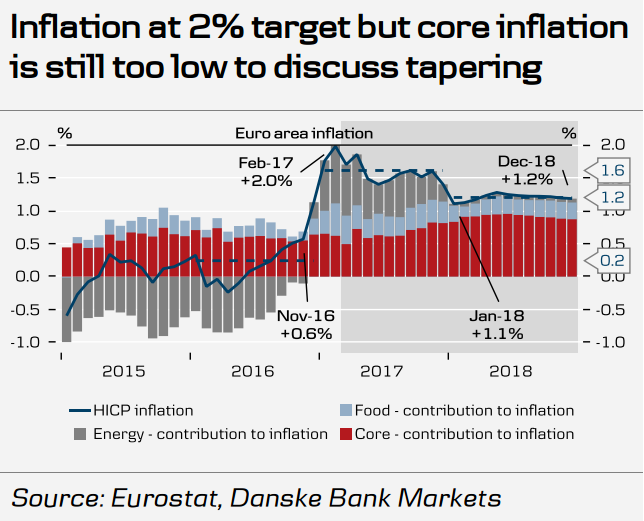
European Central Bank (ECB) holds monetary policy meeting on 9th this week and we expect no changes to main rates or QE program. The ECB will also publish new growth and inflation projections. The ECB has maintained an ultra-loose monetary policy to stimulate growth in the eurozone and avoid deflation. In December, the ECB said it would extend its bond-buying programme until at least December 2017, although the €80bn-a-month quantitative easing (QE) scheme will be trimmed to €60bn a month from April.
Eurozone inflation has risen above the ECB's target rate for the first time in four years, data from statistical agency Eurostat showed last week. Inflation in the 19-nation bloc hit 2 percent in February, up from a rate of 1.8 percent the month before. February's core inflation rate - which strips out the impact of energy and food prices - was unchanged at 0.9 percent.
The ECB has clearly communicated in the introductory statement from the latest meeting that ‘the Governing Council will continue to look through changes in HICP inflation if judged to be transient and to have no implication for the medium-term outlook for price stability’. Since the stronger inflation figure in February was largely driven by the volatile energy and unprocessed food price inflation, and whereas the underlying price pressure remained weak, we do not expect the ECB to alter its current stimulus programme.
That said, economic data has been improving steadily in recent weeks. The Euro-Zone Citi Economic Surprise Index finished last week at +70.0, up from +55.9 in the prior month. On the other hand, despite the German and Euro-Zone CPIs running through +2 percent, the 5-year, 5-year inflation swap forwards, ECB's favourite measure, have slipped back the past month, finishing at 1.705 percent at the end of last week from 1.774 percent four-weeks ago.
Investors will focus on comments by ECB President Mario Draghi. Draghi is likely to balance out his optimism over near-term economic data against longer-term concerns amidst unfolding political uncertainty. It seems likely that he’ll downplay the ECB’s faith that inflation is returning in a meaningful way as there are still no signs of underlying price pressure, which will be highly dependent on a pick-up in wage pressure.
"We expect the ECB to maintain its dovish stance at the meeting this week although inflation has reached the 2% target. We still believe the ECB will extend its QE purchases beyond December 2017," said Danske Bank in a report.
EUR/USD was 0.39 percent down on the day at 1.0579 at around 1215 GMT. Meanwhile, FxWirePro's Hourly Euro Strength Index remained neutral at 41.9771 (a reading above +75 indicates a bullish trend, while that below -75 a bearish trend). For more details, visit http://www.fxwirepro.com/currencyindex.







