


 WordPress Malware Uses Ethereum to Evade Removal
  Bitcoin Posts 42.7% Q3 Gain as ‘Uptober’ Begins Amid Crypto Turmoil
  Evernorth Set for Nasdaq Debut With 473 Million XRP Treasury
  XRP Rises as Evernorth Merger Vote Clears Key Nasdaq Hurdle
  Ripple Locks 700 Million XRP Back in Escrow After October Release
  Chainalysis AI Traces $387M Bitget Hack in Under 10 Minutes
  AI Agents Could Disrupt Financial Services, Bernstein Says
  Cardano Price Struggles as NIGHT Token Surges 20%
  Michael Saylor Sees Strategy, Strive Expanding Bitcoin Credit Market
  Robinhood Stock Nears $114 as Jobs Data Boosts Risk Appetite
  Midnight NIGHT Token Surges 86% as Smart Contract Launch Nears
  XRP Ledger Hits 10 Million AI Payments as Bitcoin Retreats
  Bitcoin Exchange Reserves Hit Multi-Year Low at 2.68 Million BTC
  AAVE, PUMP, WLD and SKY Rally as Crypto Market Slips
  NEAR Intents Hack Drains $3.8 Million, NEAR Price Falls 7.5%
  Ripple and Cardano Expand Blockchain Adoption in Brazil
  MSTR Stock Rises 3% as Strategy Challenges MSCI Bitcoin Stance


 Add as a preferred source on Google
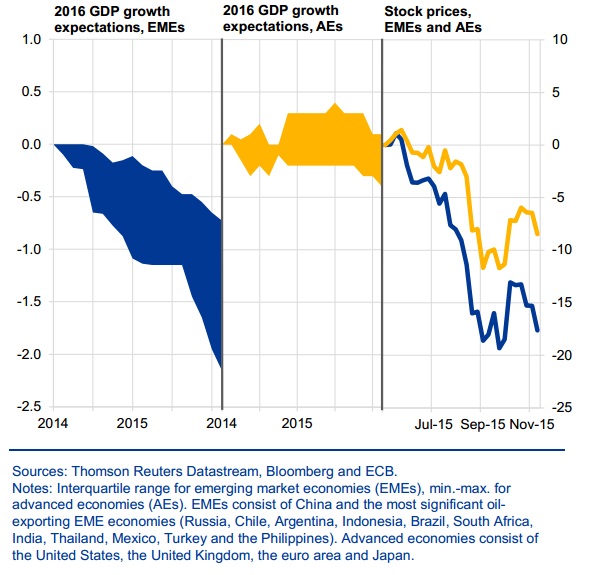
According to latest European Central Bank's (ECB) forecast in financial stability report, emerging market slowdown is likely to persist next year.
BTG's incident from Brazil is a nice example, where the Bank's CEO has been arrested over his links to Petrobras scandal. Andre Esteves, Brazilian billionaire, credited to transforming BTG into Latin America's largest investment bank. You can check out the story at http://www.bloomberg.com/news/articles/2015-11-25/btg-s-andre-esteves-senator-amaral-arrested-brazil-police-say
It shows, how vulnerable emerging market and companies are not just only to slow down or commodities' decline but also to corruption scandal at large. To remind you, Malaysian Prime Minister facing similar situation over 1MDB.
While some emerging markets have greater exposure to commodities and energy (Malaysia, Indonesia, Peru, Chile, Brazil etc.), some has heavy exposure to China (Singapore, Taiwan, South Korea ect.) and these macro themes (lower oil, slower China) responsible for their weakness are likely to continue, hence the weakness too).
These weakness, even if recovers from here likely to make a dent in advanced economies and hence the spiral of weakness back again.
European Central Bank (ECB) is considering emerging market weakness to be Europe's top vulnerability and according to ECB forecast, emerging markets' GDP on an average to shrank more than 2% in worst case scenario and -0.7% under best case.







