


 Cardano Price Drops 14% as ADA Funding Rate Hits Four-Month Low
  Morgan Stanley Raises Coinbase Stock Price Target to $258 Ahead of Earnings
  XRP Holds Steady at $1.39 as Crypto Market Faces Heavy Liquidations
  XRP Ledger Activates New Security Feature for Banks and Stablecoins
  Crypto Liquidation Flush: BTC & ETH at a Glance
  XRP Price Eyes $1.50 as ETFs Attract $8.17M Inflows
  Ledger Investigates Alleged $86 Million Crypto Wallet Theft
  Solana Price Drops 3% Despite Samsung USDC Partnership
  Bitcoin Rebounds to $82K as Crypto Market Faces Weekly Losses
  GRAM Price Jumps 9% as Telegram Expands Money Wallet
  Stellar Overtakes Ethereum in RWA Fund Inflows as XRP Leads Commodities
  MSTR Stock Rises as Barclays Raises Price Target to $175


 Add as a preferred source on Google
This year emerging market has been ravaged by outflow of money which has pushed currencies of many countries, such as Brazil, Indonesia, South Africa, Chile, and India to multi-year low against Dollar.
- While currencies have depreciated a lot, investors have taken money out of emerging market equities. Data from EPFR, a global fund flow statistics provider, shows investors have pulled out billions of Dollars from emerging market equity funds for ninth consecutive week, making outflow (net flow) of $58.2 billion so far this year.
- Chinese market equity turmoil is undoubtedly an out layer scenario, with index losing 40% of its value since June, indices are down, all across emerging markets. Indian equities, which was initially up for the year is now down close to 5%.
All have happened in anticipation of rate hike from US Federal Reserve. Naturally many analysts fear that situation might get uglier when FED actually hike rates.
Despite the crisis, Emerging market debts have performed relatively well, and fear is rising it might start crumbling with rise in US interest rates.
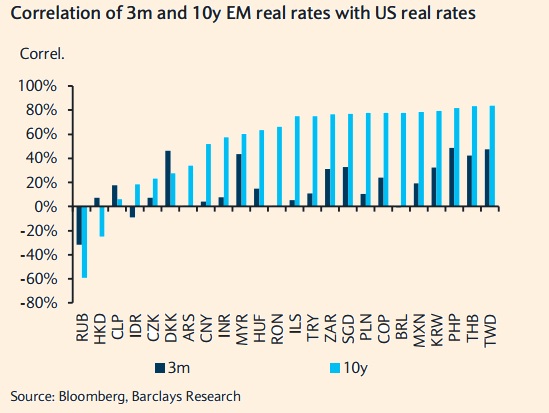
Charts from Barclays Research, courtesy of Financial Times, show that emerging markets real rates are likely to rise with rise in US real rates and FED's move might just do that.
- Emerging economies such as Taiwan, Thailand, Mexico, Brazil etc. all have very high correlation with US real rates, especially in the longer end of the curve (above 60%). It would strain emerging market corporates who are already burdened with excessive debt.
- Shorter end shock could be more discreet as some economies have high correlation with shorter end curve. Countries like Malaysia, South Africa, Singapore, Philippines, Taiwan, Thailand, turkey have relatively higher sensitivity to shorter end rise making them extra vulnerable.







