Black people continue to be overrepresented at all levels of the Canadian justice system. According to the Correctional Service of Canada, nine per cent of offenders in custody were Black in 2020-2021, despite only representing about four per cent of Canada’s population.
As community activists, we delve into the pressing issue of anti-Black racism in the Canadian justice system and how the implementation of Impact of Race and Culture Assessments (IRCAs) can reduce the over-representation of Black people in the justice system. This is significant as it goes beyond a one-size-fits-all punitive approach that has shown to be ineffective.
Anti-Black racism within institutions
Anti-Black racism is not unique to the criminal system. According to the 2019 General Social Survey, 46 per cent of Black people aged 15 and older reported experiencing at least one form of discrimination. That is compared to 16 per cent of non-racialized people.
The intersection of anti-Black racism, systemic barriers in education, and over-policing of racialized communities all play a role in perpetuating the problem.
Black youth continue to be disproportionately streamed into lower education tracks. Invisibility in curricula, stereotypical thinking about Black cultures, and the predominantly white demographic makeup of educators contribute to the perpetuation of the school to prison pipeline which funnels Black youth into the criminal justice system.
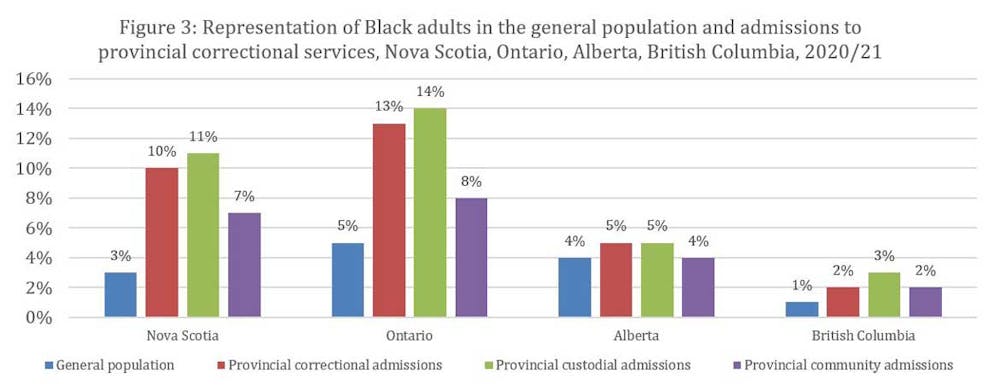
Data shows that Black people continue to be incarcerated at a disproportionately high rate across Canada. (Statistics Canada)
The need for IRCAs
The 1999 landmark Supreme Court of Canada case, R. v. Gladue, established that as part of sentencing Indigenous offenders, the judge must consider:
-
The unique systemic or background factors which may have played a part in bringing the particular Indigenous offender before the courts; and
-
The types of sentencing procedures and sanctions which may be appropriate given the circumstances for the offender because of their particular Indigenous heritage.
The Gladue report emerged from the case acknowledging the need to consider the unique circumstances of Indigenous individuals as part of equitable sentencing. It highlighted how historical injustices, systemic discrimination and cultural factors play a significant role in shaping the lives of Indigenous offenders.
Currently, IRCAs can be used for Black offenders facing jail time of two years or more or a youth facing a custodial sentence. By recognizing the racial systemic injustices Black people face, IRCAs enable judges to make more informed decisions that can lead to more equitable consequences. IRCAs provide context for the disadvantages and systemic racism faced by Black offenders and offers recommendations for alternatives to incarceration.
However, IRCAs are inconsistently implemented across provinces and used occasionally in Ontario and Nova Scotia. IRCAs must be done by clinical social workers to provide judges and parole boards with a more complete picture of an individual’s personal background, specifically their past traumas and impact of such experiences in engaging in criminality.
In 2021, the federal government provided funding to legal aid to implement IRCAs. By acknowledging historical and systemic biases and tailoring interventions to individual identities and life experiences, IRCAs have the potential to transform the criminal justice system.
Reintegration with the support of community organizations
The Gladue process must be adapted to provide IRCAs more comprehensively for Black offenders. This would promote equitable justice giving consideration for Black offenders’ backgrounds, traumas, and the intergenerational impacts of discrimination and marginalization.
The involvement of Black community organizations is crucial in guiding the implementation of IRCAs. Black community organizations hold a wealth of knowledge and lived experiences that are indispensable in crafting effective IRCAs. Their leadership can ensure that the process is respectful, culturally reflective, and responsive to the unique challenges faced by Black individuals within the justice system.

Anti-Black racism is not unique to the criminal system and many Black youth continue to face systemic barriers in education. (Shutterstock)
For example, the Youth Association for Academics, Athletics, and Character Education (YAAACE) is a Black-led non-profit organization housed in Toronto’s Jane and Finch community that is advocating for the implementation of IRCAs and exploring alternatives to custody in community settings. A co-author of this story, Ardavan Eizadirad, is the executive director of YAAACE.
Such community organizations can serve as bridges between incarceration facilities and institutions fostering trust and cooperation. This is critical to shift away from a narrative that blames racialized communities for violence to one that works collaboratively with them to mitigate the risk factors that gravitate people towards violence.
Recidivism rates remain high for Canada showing that the current justice system is not very efficient in promoting rehabilitation and reintegration back into community.
Co-author Greg Leslie is a Black social worker and psychotherapist with over 25 years of experience. Unaddressed race-based traumas contribute to severe mental health problems. Culturally reflective services that address traumas experienced by Black individuals and families, particularly due to gun violence, are vitally important. Trauma-focused therapy and Cognitive Behaviour Therapy can provide compassionate support and acknowledge the unique cultural complexities of a person’s experiences.
Investing in more equitable justice
To ensure effective implementation of IRCAs, some key investments are required:
Training and education: Legal professionals, judges, police officers, and correctional staff must undergo comprehensive training on cultural competence and learning about the historical context of systemic anti-Black racism in Canada.
Data collection and government support: Accurate and consistent data collection is crucial to measure the impact of IRCAs and address potential disparities in implementation. Collaboration between government agencies, academic institutions, and community organizations are necessary. All levels of government must provide adequate resources and funding to support implementation of IRCAs.
IRCAs hold the key to creating a more just and equitable Canadian justice system. By recognizing how racism and injustice impact people’s lives, IRCAs can transform Canada’s justice system through equitable sentencing, contributing to reduced recidivism, community healing, and overall safer communities.