


 Gold Prices Fall Amid Rate Jitters; Copper Steady as China Stimulus Eyed


 Add as a preferred source on Google
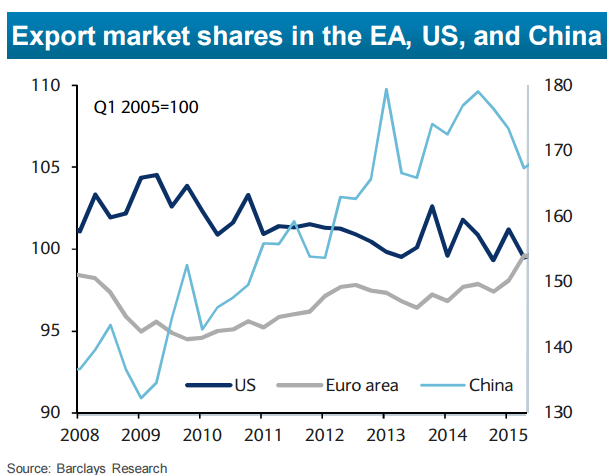
Euro area Q2 GDP growth was in line with the expectations (+0.4% q/q), although stronger exports offset a significant investment contraction and a slowdown in consumption. The strength in exports in H1 15 (5.5% SAAR) was at odds with the weakness of foreign demand (+1.5% SAAR) and probably resulted from the lagged effect of euro depreciation in H2 14 on a real trade-weighted basis, which boosted euro area competitiveness.
Exports are expected to grow more in line with foreign demand from H2 15 and therefore to slow as a result of the weakness of the global economic environment, dragged down by a slowdown in China and other EM countries. Net exports in the euro area is expected to contribute only 0.1pp to annual GDP growth in 2016, versus 0.3pp in the July forecast. August trade data for Germany, just released on 7 October, suggest that this projection is subject to downside risks.

- News

- Economy

- Central Banks
- Investing
- Research
- Roundups
- Digital Currency
- Insights
- Technical Analysis
- Technology
- Business
- Law
- Health
- Nature
- Fintech
- Science
- Topic
- Opinions
- ©Econometrics LLC . All Rights Reserved.
Euro area recovery still on track despite a global slowdown
Tuesday, October 13, 2015 9:29 PM UTC
Editor's Picks



- Market Data
Most Popular




