


 Fed’s Hammack Says Bond Yield Surge Is Not Driven by Inflation Fears
  RBA Signals More Rate Hikes as Inflation Risks Rise
  Oil Prices Surge Above $106 After Deadly Saudi Airport Attack
  Best Gold Stocks to Buy Now: AABB, GOLD, GDX
  Oil Prices Rise as Houthi Attacks Threaten Middle East Supply
  RBI Raises Repo Rate to 5.50% in Hawkish Shift on Inflation Risks
  Philippines Current Account Deficit Seen at $19.1 Billion in 2026
  Gold Prices Rebound as Dollar Weakens Ahead of US Inflation Data
  IMF, World Bank Meetings Face Global Economic Risks Amid Iran War


 Add as a preferred source on Google
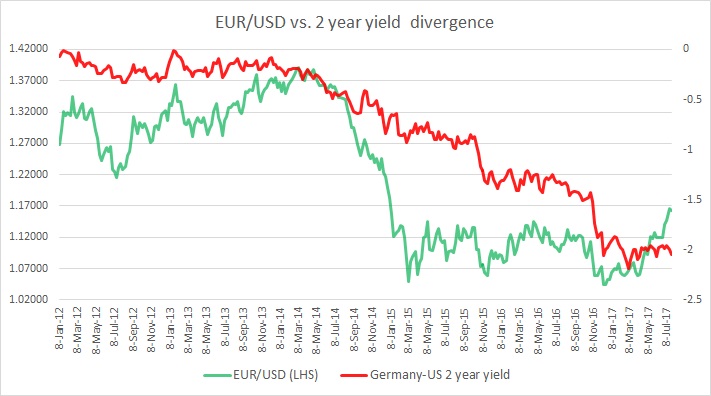
The chart above shows, how the relationship between EUR/USD and 2-year yield divergence has unfolded since 2012. It is evident that these short rates have been a key influencing factor for the pair as policy divergence became evident since 2013.
Past divergence and move in the exchange rate:
- As the speculations of Federal Reserve's withdrawal of the extraordinary monetary stimulus became frenzy since the beginning of 2014, yield divergence between German 2 year bond (considered as European benchmark) and the US 2 year note went from -0.18 percent at the beginning of 2014 to -0.78 percent by the end of the year and EUR/USD declined from 1.367 to 1.2 by year end.
- We saw further drop in the EUR/USD exchange rate in 2015 as ECB introduced monetary stimulus but the yield failed to follow that fast. It only started declining as the expectations for further stimulus grew and by end of December, declined more than 50 basis points compared to the first quarter of 2015.
- European Central Bank (ECB), however, disappointed in December 2015 and only to deliver in Ma h, 2016. Since December, Germany-US yield divergence has moved in a range lacking clear direction as the Fed became more cautious than expected. So had the EUR/USD.
- From summer last year, the yield spread has started declining again and after Donald Trump won the US presidency, the spread has widened sharply. In August, the spread was at 1.35 percent and it deteriorated to -1.43 percent just before the US election and in December it reached -1.87 percent. Similarly, the euro has declined from 1.11 against the dollar, prior to the election to 1.065 in December
- In a review in February, we discussed that the yield spread has widened further by almost 20 basis points. However, the exchange rate hasn’t followed through, and we pointed to the divergence building up.
- In our review in May, we noted that while geo-political factors are playing key role in influencing EUR/USD, the yield spread is also playing its part. The recent spike in the EUR/USD exchange rate coincided not only with the French election outcome but a narrowing of the spread too.
- In our last review in June, we pointed that the spread has narrowed by only by 5 basis points, while euro has moved up against the dollar by more than 250 pips, pointing to a divergence, which means that there could be a correction in the euro against the dollar or in the bond spread.
- Since that review, the divergence between the exchange rate and the yield spread has widened further. Since that review the spread has widened further by 10 basis points in favor of the dollar, however, the euro has gained more than 400 basis points against dollar.
- It is important to note that while speculations of ECB winding up its monetary stimulus is pushing the euro higher the sentiment is not being reflected in the bond market. But that doesn't mean that euro will decline, as it can be seen that the exchange rate moves faster than the bod spread at times of speculation.







