


 Moldova Criticizes Russia Amid Transdniestria Energy Crisis
  DeFi Development Adds 22,070 SOL to Solana Treasury
  Morgan Stanley Predicts $10 Trillion RWA Market by 2030
  Gold vs Bitcoin: Investors Eye Inflation Hedge as Crypto Adoption Grows
  China’s Growth Faces Structural Challenges Amid Doubts Over Data
  UNCX Network Hack Drains $86K From Ethereum Token Pool
  Polygon Labs Completes Coinme Acquisition, Expands U.S. Payments
  Bank of America Posts Strong Q4 2024 Results, Shares Rise
  UBS Projects Mixed Market Outlook for 2025 Amid Trump Policy Uncertainty
  European Stocks Rally on Chinese Growth and Mining Merger Speculation
  Ripple Mints 19.6 Million RLUSD Amid Banking Expansion
  Gold's Tug-of-War: Geopolitical De-escalation Fights Falling Yields as Markets Eye US CPI
  U.S. Stocks vs. Bonds: Are Diverging Valuations Signaling a Shift?
  Pi Network Price Eyes $0.10 Ahead of Protocol 28 Upgrade


 Add as a preferred source on Google
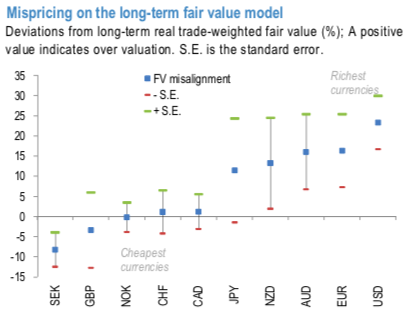
There has been substantial FX market moves over the past month and this has led to some changes in the ranking of currencies on this framework.
The positive momentum of the FOMC minutes for the US dollar did not last long. Despite the fact that market observers seemed to agree that the US central banker’s assessments are much more optimistic based on the minutes than both the statement of the meeting and Fed chair Jay Powell had suggested in the press conference. The reserved reaction of USD exchange rates suggests that most had assumed a slightly less pronounced change of direction on the part of the Fed and that this was more or less confirmed by the minutes.
Contrary to the dollar the euro is very much moved by the monetary policy outlook. That is likely to be due to the fact that the economic situation in the eurozone seems much more critical at present than in the US, the market is likely to increasingly expect expansionary ECB measures, which would put further significant pressure on the euro.
On the cheaper end of the spectrum, following SEK’s notable underperformance over this period, SEK now screens as the cheapest currency on this framework. Meanwhile, GBP outperformance over the same period has nudged the currency closer to fair value (refer 1st chart). While GBP valuations are not at an extreme yet, SEK’s undershooting is now approaching decade-lows and may indicate some limits to how much recent underperformance can extend (refer 2nd chart).
The ranking is relatively unchanged on the rich end of the spectrum, with USD, EUR and the Antipodean FX still featuring on that list. Among the funding currencies, CHF is the only one near fair value, with USD the richest, followed by EUR and JPY. Yet, None of these valuations are at an extreme indicating that movement in either direction is possible.
While the richness of the Antipodean FX has come off the peak, both AUD and NZD continue to look overvalued relative to the G10 petro-FX. Both NOK and CAD continue to be near fair value on this framework (refer 3rd chart).
Positive news as regards the trade negotiations between the US and China, and in addition a strong Australian labor market report. As a result, the extent of the collapse in AUD this morning comes as somewhat of a surprise. In particular, as it is said to have been initially triggered by an Australian bank lowering its growth outlook and now forecasting two RBA (Reserve Bank of Australia) rate cuts this year. Courtesy: JPM & Commerzbank
Currency Strength Index: FxWirePro's hourly EUR is at 37 (mildly bullish), hourly USD spot index is inching towards -39 levels (mildly bearish), hourly AUD is at -120 (highly bearish) while articulating at 13:05 GMT.
For more details on the index, please refer below weblink: http://www.fxwirepro.com/currencyindex







