


 NZDJPY Technical Outlook: Bullish Momentum Builds as Price Tests Key Support Levels
  Moody's Upgrades Argentina's Credit Rating Amid Economic Reforms
  FxWirePro: USD/ZAR rises as hot US inflation boosts Fed rate hike bets
  UBS Projects Mixed Market Outlook for 2025 Amid Trump Policy Uncertainty
  FxWirePro: AUD/USD edges higher as US CPI looms large
  UBS Predicts Potential Fed Rate Cut Amid Strong US Economic Data
  Goldman Predicts 50% Odds of 10% U.S. Tariff on Copper by Q1 Close
  S&P 500 Relies on Tech for Growth in Q4 2024, Says Barclays
  Urban studies: Doing research when every city is different
  US Futures Rise as Investors Eye Earnings, Inflation Data, and Wildfire Impacts
  FxWirePro: GBP/USD slipped lower as US inflation reinforces hawkish Fed outlook
  FxWirePro: EUR/AUD gains slightly, but downward resumption looks likely
  FxWirePro- Major Pair levels and bias summary
  FxWirePro: USD/JPY eases slightly , but outlook is bullish
  China's Refining Industry Faces Major Shakeup Amid Challenges
  FxWirePro: GBP/NZD uptrend loses momentum but bullish setup remains
  Trump’s "Shock and Awe" Agenda: Executive Orders from Day One


 Add as a preferred source on Google
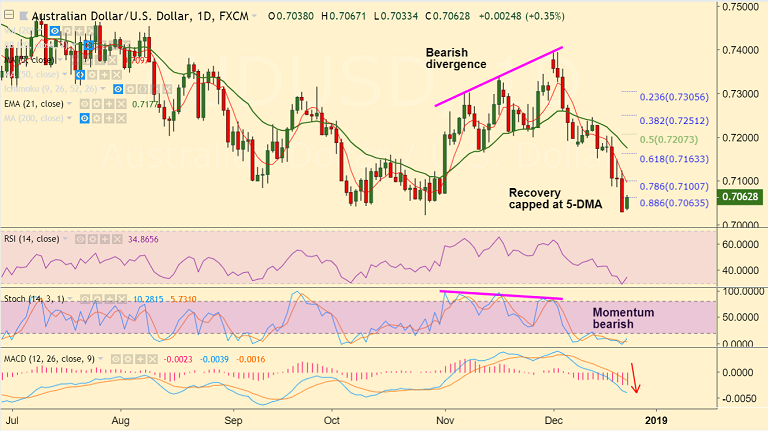
AUD/USD chart on Trading View used for analysis
- AUD/USD has edged higher on the day and is trading at 0.7496 at the time of writing.
- Recovery in the pair lacks traction and we see major resistance at 1H 21-EMA at 0.7067.
- With broader economic slowdown impeding investment and US-China trade tensions still looming over sentiment, downside in the pair remains intact.
- According to a statement by China's Ministry of Commerce over the weekend, a vice-ministerial-level call between the US and China saw "a deep exchange of views" on trade imbalances and intellectual property protections.
- But, traders wait for concrete results and vague headlines will likely provide little optimism in the markets.
- AUD/USD has been on a major downtrend and recovery was capped at 200-DMA before the pair resumed downside with a bearish divergence.
- The pair has hit new 9-week lows at 0.7029 on Friday's trade. And further weakness will see test of 0.69 (Aug 2015 lows) ahead of 0.6827 (Jan 2016 low).
- On the flipside, breakout at 5-DMA could see upside till 21-EMA at 0.7177. Bearish invalidation only above 200-DMA.
For details on FxWirePro's Currency Strength Index, visit http://www.fxwirepro.com/currencyindex.







