


 Hyperliquid (HYPE) Price Analysis: Can Bulls Push Above $88?
  XRP Ledger Foundation Confirms 100B Supply Safe After Security Fix
  Stock Futures Dip as Investors Await Key Payrolls Data
  Global Markets React to Strong U.S. Jobs Data and Rising Yields
  Urban studies: Doing research when every city is different
  US Gas Market Poised for Supercycle: Bernstein Analysts
  Arthur Hayes Announces FLOP Testnet Launch Within Weeks
  DeFi Development Adds 22,070 SOL to Solana Treasury
  Oil Prices Dip Slightly Amid Focus on Russian Sanctions and U.S. Inflation Data
  U.S. Treasury Yields Expected to Decline Amid Cooling Economic Pressures
  Gold Prices Slide as Rate Cut Prospects Diminish; Copper Gains on China Stimulus Hopes
  Monero Price Holds $515 Support as XMR Eyes $545 Breakout
  Zcash Price Drops 30% as ZEC Tests Critical $1,120 Support
  China's Refining Industry Faces Major Shakeup Amid Challenges
  Crypto Derivatives Dashboard: Bulls Retain Control Amid $488M Liquidation Flush
  Zcash Price Analysis: Can ZEC Rebound Above $1,300?


 Add as a preferred source on Google
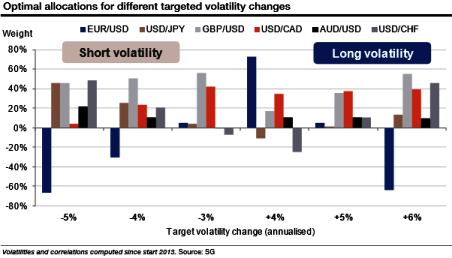
Targeting volatility via optimal portfolios:
An aggressive trader or investor keen on the volatile asset class targets a rise or fall measured in volatility points.
However, the Markowitz framework can be used to design optimal allocations which correspond to the volatility change targeted by the investor.
The main observations on the six optimal allocations obtained with the data sample since the start of 2013 follow below (see graph):
AUD/USD volatility generally has a small weight while the EUR/USD and GBP/USD tend to have large absolute weights.
All allocations (buying and selling volatility) are buying GBP/USD and USD/CAD volatility.
Long volatility portfolios are underweighted in USD/JPY volatility.
Targeting either a large rise or fall involves massively selling EUR/USD volatility and buying the five others.
The biggest long USD/JPY volatility exposure is found to target a large volatility fall.
The corresponding portfolio will be efficient in the sense that it will be diversified and exposed to the minimal level of risk given the targeted return. In that way, the expected return becomes an exogenous input.
Obtaining the optimal allocations equates to a slide on the efficient frontier. We compute the optimal allocations corresponding to targeted volatility increases and falls. The order of magnitude of these investing scenarios corresponds to the historical scenarios.
The numbers reflect the usual asymmetry with volatility increasing more than it falls (the return of the naive allocation is a gain of 4.9 points in the rising case, whereas the falling case sees a gain of only 4 points).







