


 China's Refining Industry Faces Major Shakeup Amid Challenges
  DeFi Development Adds 22,070 SOL to Solana Treasury
  Zcash Price Drops 30% as ZEC Tests Critical $1,120 Support
  U.S. Treasury Yields Expected to Decline Amid Cooling Economic Pressures
  Global Markets React to Strong U.S. Jobs Data and Rising Yields
  US Futures Rise as Investors Eye Earnings, Inflation Data, and Wildfire Impacts
  Mexico's Undervalued Equity Market Offers Long-Term Investment Potential
  Bitcoin Price Drops as US Dollar Hits 18-Month High
  Goldman Predicts 50% Odds of 10% U.S. Tariff on Copper by Q1 Close
  Geopolitical Shocks That Could Reshape Financial Markets in 2025
  XRP Ledger Foundation Confirms 100B Supply Safe After Security Fix
  UBS Projects Mixed Market Outlook for 2025 Amid Trump Policy Uncertainty
  2025 Market Outlook: Key January Events to Watch
  China’s Growth Faces Structural Challenges Amid Doubts Over Data
  Urban studies: Doing research when every city is different
  Monero Price Holds $515 Support as XMR Eyes $545 Breakout
  Wall Street Analysts Weigh in on Latest NFP Data


 Add as a preferred source on Google
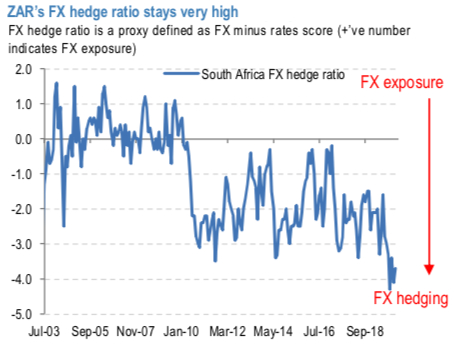
There are some technical positives for ZAR, which under normal circumstances may be sufficient to stabilize the currency, but amid end-of cycle concerns are probably not a good guide. For completeness, we review valuation and positioning below. Despite the small correction in March, the FX hedge ratio remains near record highs (refer 1st chart).
This suggests many real money investors are already pre-hedged for the upcoming downgrade risks. In addition, ZAR now screens 8.1% cheap in our BEER FV model, the lowest since September 2018 (refer 2nd chart). These technical positives somewhat reduce ZAR’s vulnerabilities.
The medium term outlook for ZAR remains very negative based on weak growth, prospects of much lower carry and a negative BoP dynamics. Yet, our risk appetite index has reached extreme low levels and ZAR is starting to screen cheap in our BEER FV model. As such we took profits on our bearish trades. Lacking directionality though momentum to keep USD/ZAR above 18.00 levels.
Consider a RUB – ZAR RV trade, supported by the earlier screener on skews: Sell 3M delta-hedged USDRUB 25D call @10.9/11.3 and hedge it with 3M delta-hedged USDZAR 25D call @16.325/16.725, equal vega. Courtesy: JPM







