


 Sector Spotlight: Data Availability and Storage Lead 24-Hour Market Gains
  Fed Rate Hike Threatens Housing as U.S. Growth Leans on AI, Citi Says
  ECB May Stop Rate Hikes After December, Capital Economics Says
  Cardano Price Eyes $0.30 as ADA Whale Activity Surges
  Litecoin Marks 15 Years as Grayscale Backs LTC ETF Push
  Kalshi Withdraws PEPE Perpetual Futures Filing
  RBA Says ASX Still Falls Short on Governance and Risk Controls
  Strategy’s STRC Nears $100, Raising Prospects for Major Bitcoin Buys
  Solana User Growth Jumps 33%, Outpacing Ethereum and Chainlink
  U.S. Government Moves Over $100M in Bitcoin and BNB
  RBI Rate Hike Bets Surge as Inflation Rises
  BofA Raises Coinbase Stock Target to $203 on Stablecoin Growth
  RBA Hikes Interest Rate to 4.60% as Inflation Risks Rise
  Zcash Privacy Demand Rises as AI Exposes Bitcoin Transactions


 Add as a preferred source on Google
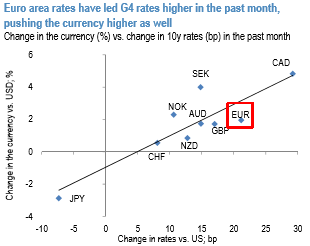
The ECB has signaled a taper announcement for September, while the Fed has been noncommittal on the timing of balance sheet normalization, prompting a Bund-led rise in DM yields which has been EUR supportive (refer above chart).
Well, it’s ECB today..! President Draghi is expected to signal a dovish tightening. Managing the communication will not be easy; at the same time seeking to maintain market expectations that policy normalization is underway, but also avoiding another bond sell-off and euro appreciation.
The base case is for the ECB to announce taper at the September meeting.
While we expect the Fed to announce balance sheet normalization in September as well, the Fed has refrained from sending a firm signal on timing thus far.
The bearish forecast reflected the view that the ECB would be quieter on the taper in the near-term.
Moreover, markets appeared better prepared for an ECB taper than for the onset of Fed balance sheet normalization, as reflected by already-long EUR positions and overshooting valuations vs rates, so any rise in yields was expected to be led by the US.
Hence, a more activist ECB warrants a modest upgrade to the EURUSD forecast, long-standing medium term forecast has been bullish (4Q at 1.15 and 2Q18 at 1.16), while our near-term forecast was bearish (3Q EURUSD target was put at 1.08).







