


 2025 Market Outlook: Key January Events to Watch
  Monero Price Holds $515 Support as XMR Eyes $545 Breakout
  China’s Growth Faces Structural Challenges Amid Doubts Over Data
  Trump’s "Shock and Awe" Agenda: Executive Orders from Day One
  Moody's Upgrades Argentina's Credit Rating Amid Economic Reforms
  Gold Prices Fall Amid Rate Jitters; Copper Steady as China Stimulus Eyed
  Navigating the Crypto Pulse: Weekly Market Resilience and Institutional Inflows
  Hyperliquid (HYPE) Price Analysis: Can Bulls Push Above $88?
  Ethereum Foundation-Linked Wallets Move $11.13M in ETH to Kraken
  Indonesia Surprises Markets with Interest Rate Cut Amid Currency Pressure
  Fed May Resume Rate Hikes: BofA Analysts Outline Key Scenarios
  U.S. Banks Report Strong Q4 Profits Amid Investment Banking Surge
  XRP Price Drops 3% Despite Ripple-Backed Evernorth Nasdaq Debut
  Gold Prices Slide as Rate Cut Prospects Diminish; Copper Gains on China Stimulus Hopes
  Lithium Market Poised for Recovery Amid Supply Cuts and Rising Demand
  UBS Projects Mixed Market Outlook for 2025 Amid Trump Policy Uncertainty


 Add as a preferred source on Google
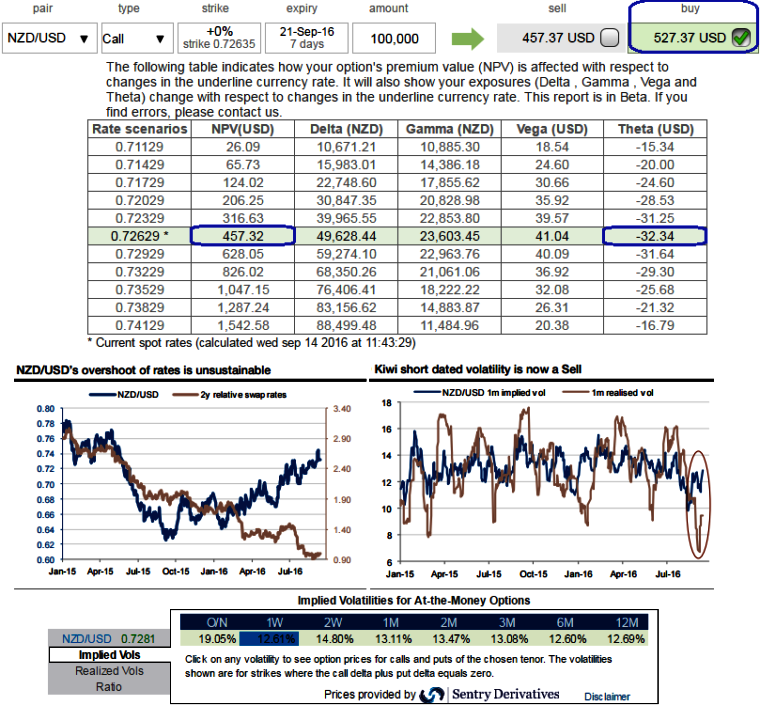
1w implied volatilities are flashing at 12.61%, while ATM calls of this time frame are priced at 15.38% more than Net Present Value. Hence, these call options are deemed as overpriced in prevailing bearish environment.
Expensive implied volatility and spot within a channel Implied volatility is elevated compared to realised volatility (see above graph), suggesting a structure selling it.
The downside skew is not sufficiently elevated to finance a put via low strikes (a put spread-like structure), but the negative skew is enough to obtain an attractive discount via a downside knock-out.
Such a barrier is appropriate for trading moderate NZDUSD downside, keeping in mind that the spot has been trapped within a bullish channel since the start of the year and that 0.70 is below the support line.
NZDUSD’s appreciation has occurred against the direction of interest rate differentials for months, and the disconnection recently widened with the latest bout of currency strength (see above Graph).
Hence, we think call writing could also be beneficial as IV skewness is conducive for prevailing bearish environment.







