


 Geopolitical Shocks That Could Reshape Financial Markets in 2025
  Bank of America Posts Strong Q4 2024 Results, Shares Rise
  US Gas Market Poised for Supercycle: Bernstein Analysts
  Stock Futures Dip as Investors Await Key Payrolls Data
  UBS Predicts Potential Fed Rate Cut Amid Strong US Economic Data
  XRP Price Drops 3% Despite Ripple-Backed Evernorth Nasdaq Debut
  Moldova Criticizes Russia Amid Transdniestria Energy Crisis
  Moody's Upgrades Argentina's Credit Rating Amid Economic Reforms
  Goldman Predicts 50% Odds of 10% U.S. Tariff on Copper by Q1 Close
  Monero Price Holds $515 Support as XMR Eyes $545 Breakout
  Gold Prices Fall Amid Rate Jitters; Copper Steady as China Stimulus Eyed
  Pi Network Price Eyes $0.10 Ahead of Protocol 28 Upgrade
  Ripple-Backed Evernorth Set for Nasdaq Debut With 473 Million XRP


 Add as a preferred source on Google
CAD sharply depreciated by as much as 4.8% from mid-April highs on a layering of multiple concerns that suddenly gathered around Canada. These risks include fresh concerns over the US-Canada trade relationship, the potential for sharply lower oil prices, and the re-emergence of housing market related financial stability vulnerabilities.
While all of these developments could potentially impart a significant negative shock to the Canadian economy and thus the currency, none of these risks have been realized yet, nor are they necessarily acute.
The lumber tariff was mostly an idiosyncratic sideshow, and NAFTA renegotiation risks are still poorly defined and medium-term, not acute.
As we discussed in a recent note, Trump Trade Policy and Canada: Signal or Sideshow?, the US-Canada lumber dispute has been ongoing for decades, the US trade enforcement action should have been well anticipated, and therefore should not be read necessarily as a signal about how the broader US-Canada trade relationship will play out.
Instead, NAFTA uncertainty remains low-grade and medium-term (the administration has not even formally started the renegotiation process, which is awaiting the confirmation of the USTR).
Costless collars to hedge aggressive bullish outlook
The nutshell above explains that hedgers’ interests have been neutral but upside risks are lingering, however, no new shift in sentiments are observed. As a result, we don’t see much traction OTM calls.
More broadly, with the post-referendum upsurge in uncertainty proving short-lived, the main drag on the economy is now expected to come through the hit to consumer purchasing power resulting from the weakness of sterling, with the bulk of the impact due to take effect in 2017.
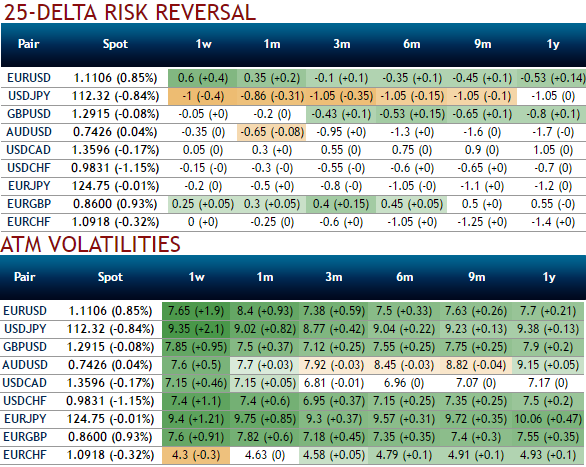
In the recent times, CAD vols skews destabilized too much especially on crude’s price sustainability, while USD volatility market normalized sharply (you could be observed that in USDCAD IV skews) which has been well balanced on both the sides. The liquidity recovered and the extreme positioning was ultimately absorbed. The price action is not taking the direction of an imminent new trend. As a result, the options market aggressively unwound smile positions.
Contemplating major trend and short-term upswings, anyone who wishes to carry long USDCAD exposures, a collar options trading strategy is recommended. This could be constructed by holding the total number of units of the underlying spot FX while simultaneously buying a protective put and shorting call option against that holding. The puts and the calls are both OTM options having the same expiration month and must be equal in the number of contracts.
The collar is a good strategy to use if the options trader is writing covered calls to earn premiums but wish to protect himself from an unexpected sharp drop in the price of the underlying security.







