


 Ripple Mints 19.6 Million RLUSD Amid Banking Expansion
  XRP Price Drops 3% Despite Ripple-Backed Evernorth Nasdaq Debut
  Ethereum Whale Moves $15.95M ETH to Kraken After Nine Years
  Oil Prices Dip Slightly Amid Focus on Russian Sanctions and U.S. Inflation Data
  Moldova Criticizes Russia Amid Transdniestria Energy Crisis
  China’s Growth Faces Structural Challenges Amid Doubts Over Data
  Bitcoin Price Drops as US Dollar Hits 18-Month High
  Bank of America Posts Strong Q4 2024 Results, Shares Rise
  Solana Alpenglow Upgrade Set for October 21: What It Means for SOL
  Global Markets React to Strong U.S. Jobs Data and Rising Yields
  US Futures Rise as Investors Eye Earnings, Inflation Data, and Wildfire Impacts
  Stock Futures Dip as Investors Await Key Payrolls Data
  Most Americans Oppose Election Betting on Prediction Markets, Poll Finds
  2025 Market Outlook: Key January Events to Watch
  Monero Price Holds $515 Support as XMR Eyes $545 Breakout


 Add as a preferred source on Google
Fundamental driving forces and risk profiling:
1) Diplomatic ties are under increasing strain
2) The real yields have declined
3) The positive effects of credit stimulus programmes from earlier this year may wane
4) The risk of early elections has increased
5) CBRT’s credibility may come under pressure and
6) Turkish residents have resumed accumulating foreign currencies.
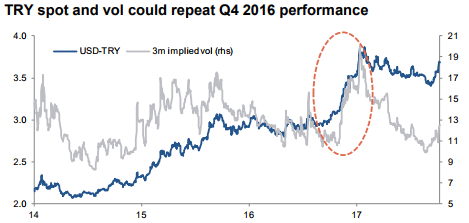
USDTRY traded up to 3.85 on the onset of the news and retraced to 3.6377 currently. We do not expect the recent diplomatic spat between Turkey and the US to have any significant macroeconomic consequences, although the headline noise could persist. The direct economic impact will be limited as US visitors account for only 1.2% of annual tourist arrivals in Turkey.
Meanwhile, the sentiment channel is clearly more important given Turkey is reliant on portfolio inflows to finance its current account deficit. However, in absence of escalation and any direct economic damage, we also expect the sentiment impact to gradually wane in coming weeks. In our view, USDTRY overshot due the stretched positioning, but positioning should now become more balanced.
Buy the tail: Relative to recent history, implied vol and risk reversals are not high. Current 3m implied vol (12.5) could spike to the 16-20 area if accelerated depreciation did occur, while risk reversals could easily rise by 1-2 vol points.
Turkish lira implied volatility and risk reversals are among the highest in emerging markets. However, relative to recent history, they are not high in their own right.
Current 3m implied vol (12.5) could spike to the 16-20 area if accelerated depreciation did occur, while risk reversals could easily rise by 1-2 vol points.
This lends itself to owning volatility, and given the difficulty in ascertaining the probabilities of a “spike followed by a recovery” versus a “trend” move higher in USDTRY, we prefer a one-touch structure over a European digital. Hence, buying USDTRY 3m one-touch knock-in 4.35 has been advocated.







