
With the parliamentary election getting over with India and with Prime Minister Narendra Modi returned to power with a sweeping victory, the Trump administration in the United States is ready to turn the focus on India and get a trade agreement done with fairer terms with the United States. Calling India a “high tariff nation” and repeatedly accusing the South Asian country of failing to provide the US with unlimited access to its markets, the Trump administration is reportedly ready to tighten the screw on trade and reduce U.S. deficits with India in goods. Last year, India enjoyed $21.4 billion goods trade surplus with the United States, down from a record $24.4 billion in 2016.
As the first step in that direction, the United States has already imposed 25 percent tariffs on steel and 10 percent levies on aluminum imports from India and in June the U.S. is likely to scrap preferential trade agreement that allows $5.6 billion worth of duty-free imports from India. In response, India accused prepared its own retaliatory measures against the US imports such as almond nuts, the introduction of which has been deferred a number of times pending the outcome of the trade negotiations with Washington.
The United States has first announced its intention to terminate India's Generalized System of Preferences (GSP) designation in March. Though the 60-day notice period is over in May, Washington hasn’t so far scrapped it but that is likely to change.
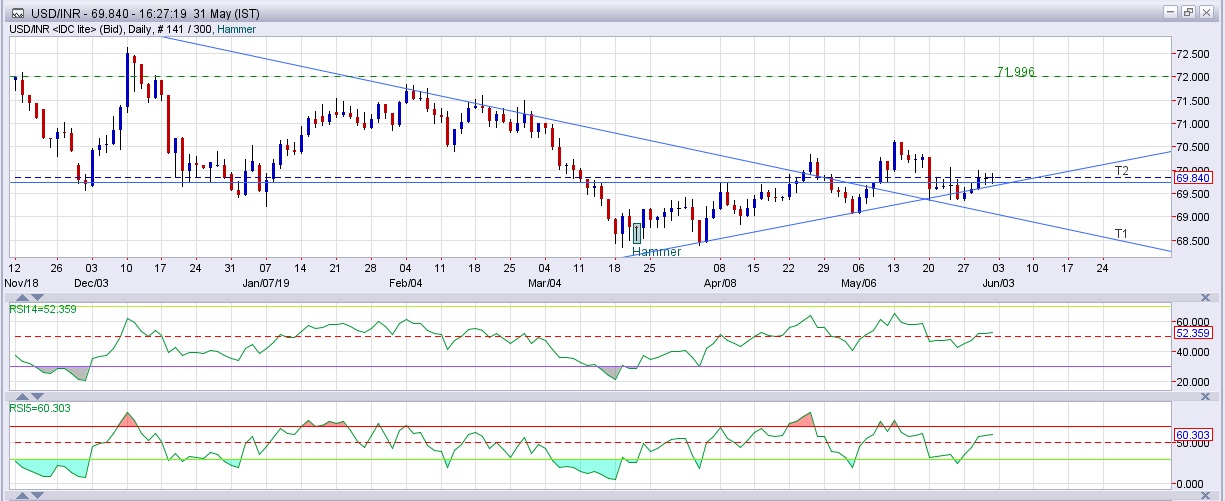
We expect the Indian rupee to weaken going forward amid Indo-American trade negotiations. The INR is currently at 69.85 per USD.

