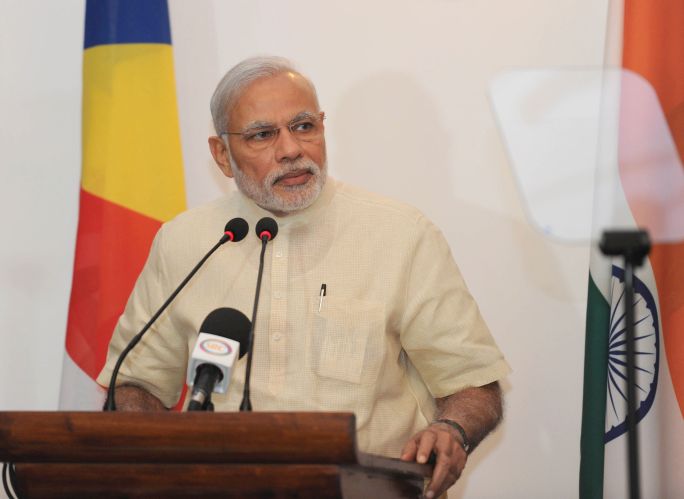
As Narendra Modi and his supporters mark a year since his re-election as India’s prime minister in May 2019, they can already point to achievements for his brand of Hindu nationalism.
In the past 12 months, India’s parliament, the Lok Sabha, has adopted a number of key laws delivering on the electoral promises made by Modi’s Bharatiya Janata Party (BJP). But their approach to governing has blended key elements of fascism – such as a controlled form of ultra-nationalism, authoritarian suppression of dissent, and an intertwining of religion and government – within a democratic framework. India’s responses to the unfolding COVID-19 crisis in the country threaten to consolidate this worrying tendency.
Modi has pronounced himself at the service of Indians rather than declaring himself their supreme leader. The BJP has largely respected the popular mandate in key states, such as Jharkhand and Maharashtra, where it lost elections since regaining its national majority in May 2019. And yet India under Modi is proving that some elements of fascism can exist inside the shell of democracy – something also happening elsewhere in the world during the pandemic.
Modi’s commitment to the Rashtriya Swayamsevak Sangh (RSS), which strives to organise society and ensure the protection of the Hindu Dharma, or way of life, is an important illustration of this entanglement of fascism and democracy. While such a commitment would likely prevent him from seizing absolute power in India, he does not shy away from styling himself as a Hindu nationalist and is pursuing blatantly Hindu nationalist politics.
The Conversation’s The Anthill Podcast ran a series in the lead up to the 2019 Indian elections called India Tomorrow. Listen wherever you get your podcasts.


Kashmir
In August, barely three months after returning to power on the back of a landslide electoral win, Modi’s government abolished Article 370 of the Indian constitution, which guaranteed a semi-autonomous status for the northern state of Jammu and Kashmir. Politicians across the state, including supporters of its accession to India, were placed under house arrest, the internet was suspended and people were placed under a lockdown that continues today.
Even as critics challenged the new law as unconstitutional, the nationalist overtones of the move promised to unite the country behind a single idea of India where there is no special dispensation for different areas. This found support not only from the BJP’s allies but also political parties that had bitterly opposed the BJP during the 2019 elections.
Violence and protest
Riding on a wave of successful legislation with little resistance in parliament, the Modi government then appeared taken aback when faced with widespread protests against the Citizenship Amendment Act (CAA) it rammed through parliament in December 2019. As the result of the CAA, and an accompanying National Register of Citizens, many of India’s 200 million Muslims could find themselves disenfranchised and stateless if they are not able to prove their citizenship. This religious filter goes against the principles of secularism in India, enshrined in its constitution.
While several state governments protested against the imposition of the draconian law without broader public consultation, a poll in December found many Indians were sympathetic to it.
Yet, recognising the threat posed by the CAA to the basic structure of the Indian constitution, millions of people across class, caste, religious and gender divides took to the streets in protest. At least 50 people were killed in violence in Delhi in February, several hundreds injured and many thousands displaced.
Coronavirus clampdown
By March, the COVID-19 crisis exploded in India. Modi announced the world’s largest lockdown with four hours notice. The worst hit were the country’s estimated 140 million migrant workers, many of who lost their jobs and were evicted. Several million of them began journeying back to the villages they call home, often on foot since public transport was suspended. India’s opposition parties demonstrated their utter ineptitude by failing to mobilise to ensure dignity and justice for the millions of migrant labourers.
The stringent lockdown has provided convenient cover for the BJP to muzzle dissent. As protestors wound up their campaigns in keeping with social distancing regulations, police in Delhi erased protest graffiti, presumably to remove any trace of the protests.
Dissidents are being rounded up and imprisoned under draconian colonial-era laws. The respected scholar-activist Anand Teltumbde being one case in point. Student-protestor Safoora Zargar another. Although India’s thriving civil society protested vociferously, it has been effectively curtailed to online forums, thanks to social distancing regulations.
The fascistic democracy brewing in India today poses extraordinary challenges for political activists committed to defending and deepening democratic freedom. After all, the Indian government justifies its actions in the interests of the nation and its people, and continues to enjoy widespread support both at home and among liberal expats abroad.
What’s happening under Modi should raise questions about the limitations of democracy as a political system. Sometimes it can facilitate rather than protect against violations of human rights and the tyranny of the majority.