


 US Government Moves $1 Billion in Bitcoin Amid Sale Speculation
  Chainlink Price Drops 3% Despite New CCIP Vault Launch
  Robinhood Buys $25 Million in Bitcoin for Corporate Treasury
  Solana User Growth Jumps 33%, Outpacing Ethereum and Chainlink
  Evernorth XRPN Nasdaq Listing Delayed to October 12
  David Schwartz to Reveal XRP Ledger Future at Ripple Swell 2026
  Circle Stock Falls 4% as Crypto Selloff Overshadows SAP Pay Expansion
  Dogecoin Liquidations Surge as DOGE Bulls Face Heavy Losses
  Kazakhstan and Tether Explore Tenge Stablecoin and RWA Tokenization
  Cardano Hits Record 436 TPS as Network Scaling Advances
  Jameson Lopp Downplays AI Threat to Bitcoin Cryptography
  Bitcoin Rebounds to $82K as Trump Eases Iran War Fears
  Bitmine to Stop Ethereum Buying After Reaching 5% ETH Supply
  Ethereum Price Drops Below $2,600 as Long Liquidations Hit 4-Month High


 Add as a preferred source on Google
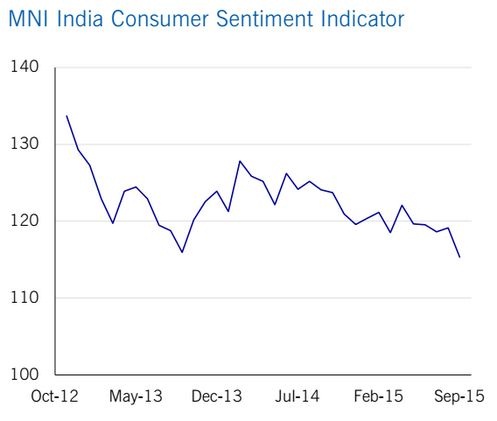
While global investors are optimistic over India, its consumers are not. While new government in the center pursuing policies that are beneficial to businesses are not so well for Indian consumers.
- Recently Indian government has increased import tariffs on steel to protect the domestic market and prevent flood of steel from Chinese market. While this move is definitely pro-business and good for the domestic industry, steel makers in India responded in gratitude with INR 1500/ton price increase.
- Similarly Indian government hasn't passed on the larger benefits of lower prices by raising taxes and duties, which will surely bring down India's deficit but will come at the cost of consumers.
Government of India's policies can be called as proxy to transfer household wealth to business and government account.
Naturally, MNI India Consumer Sentiment Indicator fell 3.2% last month to 115.3, lowest since the survey launched in November 2012.
If the government would take note, respondents were least optimistic about household finances. Its measures of current and future personal finances each fell to record lows.
However Indians are more optimist over economic developments.
India's benchmark stock index, Nifty is currently trading at 8155, up close to 5%, since Reserve bank of India introduced 50 basis points rate cut last month.







