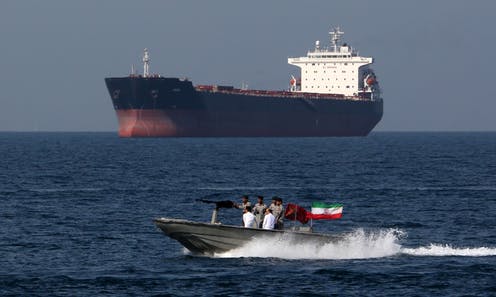
Iran’s Revolutionary Guards said Tuesday that its naval forces captured a U.S. uncrewed submarine near the entrance to the Strait of Hormuz, highlighting the growing role of autonomous underwater drones in modern military operations.
Iranian state media identified the vessel as a Dive-LD, a large autonomous underwater vehicle manufactured by California-based defense technology company Anduril. The 19-foot (5.8-metre) underwater drone is designed for missions including intelligence gathering, seabed mapping, mine countermeasures and inspections of critical underwater infrastructure such as pipelines and cables.
The Revolutionary Guards Navy claimed it had trapped one of the U.S. military’s most advanced unmanned submarines at the strategic waterway, saying the vessel contained modern technology.
The Pentagon offered a different account, saying an underwater drone had malfunctioned more than a day earlier while surveying regional waters in support of ongoing U.S. operations.
A Pentagon spokesperson described the vessel as an older model and said the defective drone was not carrying classified sonar or radar equipment and had not collected sensitive information.
Reuters could not independently confirm Iran’s account, while the Pentagon did not directly address whether Iranian forces had seized the malfunctioning vehicle. Anduril did not immediately respond to a request for comment.
The incident comes as the U.S. military expands investment in autonomous naval technology, including unmanned surface vessels and underwater drones. Such systems can conduct surveillance, collect intelligence and monitor hostile ships or submarines across large maritime areas without exposing sailors to the same level of risk.
According to Anduril, the Dive-LD can remain operational for up to 10 days before returning to base and can descend to depths of approximately 6,000 metres (19,700 feet).
DefenseScoop reported in 2024 that each Dive-LD costs roughly $2.5 million.
The reported capture near the Strait of Hormuz is particularly significant because the narrow waterway is a critical route for global energy shipments and has become a major focus of U.S.-Iran military tensions.