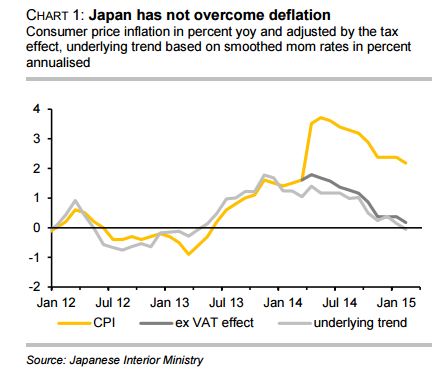
The rate of inflation was meant to reach 2% within the space of two years, the Japanese central bank had said in 2013. That does not seem to have worked out. Even though the statistics for February record a level of 2.2%…
The rate of inflation was meant to reach 2% within the space of two years, the Japanese central bank had said in 2013. That does not seem to have worked out.
Even though the statistics for February record a level of 2.2% yoy, adjusted by the effect of the sales tax hike in April 2014 the rate is more or less at zero - and displaying a downward trend. Optimists might hope that all this might simply be the effect of the recent fall in the oil price.
The core rate - i.e. inflation excluding the volatile components "energy" and "fresh food" - is even lower at 2.0%.
According to Commerzbank there are two reasons for this:
(1) Food prices have risen notably in Japan therefore making the overall inflation rate seem better than it is.
(2) The energy component only made a relatively small negative contribution to overall inflation. Energy prices in Japan are only 2.1% below the previous year's level - a result of the yen depreciation in Q4/2014. In other countries the fall of the oil price had a much more notable effect. In the US for example energy prices in the CPI basket are 19% below the level recorded 12 months ago.
Gold prices edged lower on Monday as stronger-than-expected U.S. nonfarm payrolls data dampened hopes for aggressive Federal Reserve rate cuts, bolstering the dollar. Spot gold slipped 0.1% to $2,686.32 an ounce, while F…
On-chain data shows BTC whales moved 10000 BTC from Crypto exchanges. This indicate accumulation of BTC by whales. Japanese public company Metaplanet buys another 1 billion yen worth of Bitcoin. According to Santiment, t…
Personal income increased by 0.2% month over month In August, which was less than the 0.4% market forecast and less than the 0.3% growth in July. For the third consecutive month, real personal disposable income increased…