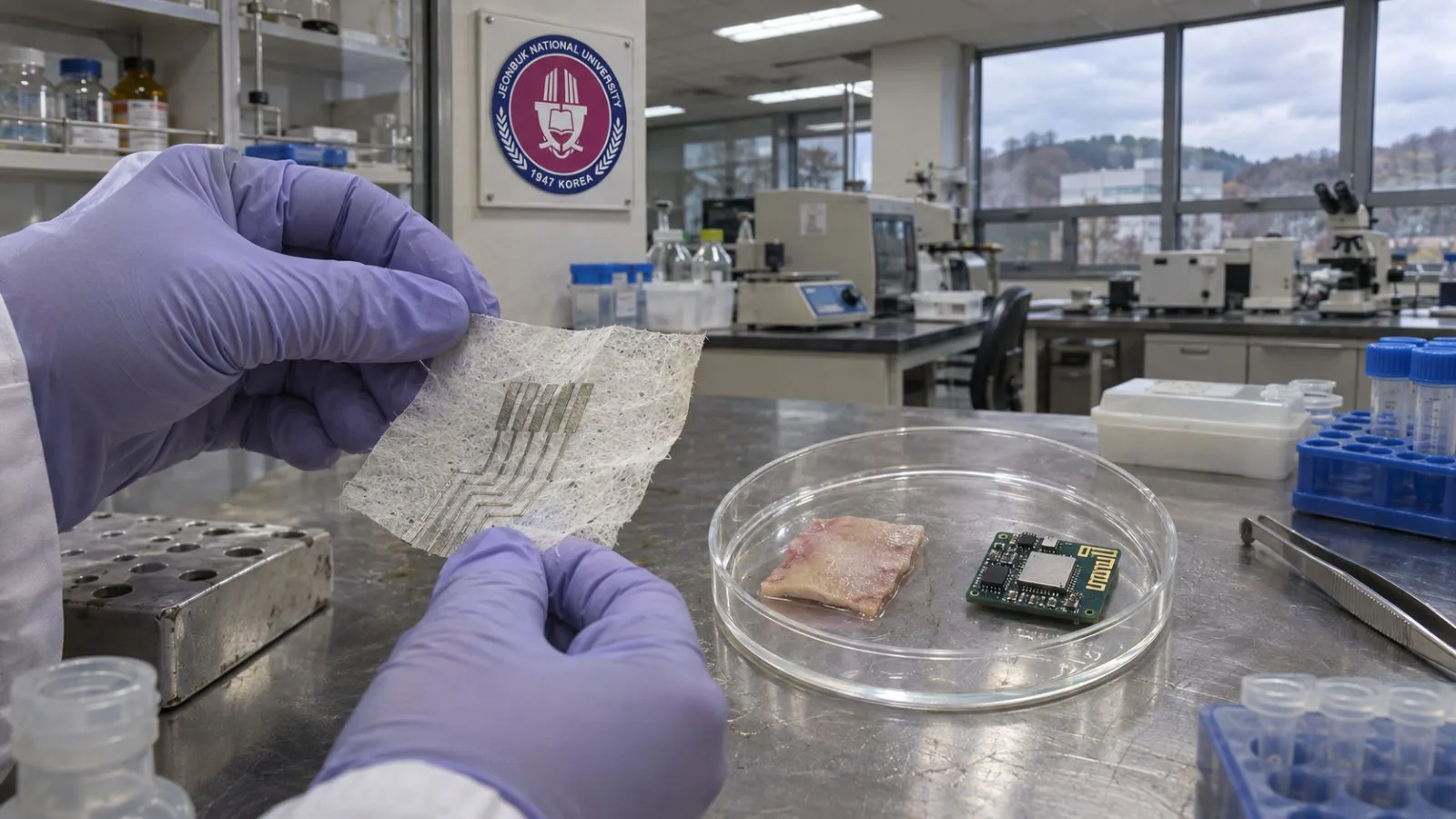
Jeonbuk National University researchers tested a breathable mulberry-paper platform for drug delivery and wireless uric-acid monitoring, targeting a design problem that can limit the comfort and reliability of wearable sweat sensors.
The system places microneedles and printed electrodes on a porous sheet. The study, published in Chemical Engineering Journal, assessed drug delivery and sensing in separate tests; it did not show the patch delivering medicine while tracking uric acid at the same time. The university said conventional patches can trap sweat, restrict airflow and cause discomfort, while the paper design could support moisture movement.
The sample wetted quickly: its measured water contact angle dropped from 72.19 degrees to 7.96 degrees after six seconds. The university said the paper’s porous fibers could help manage sweat accumulation, which can interfere with sensor readings.
Using light-based 3D printing, researchers formed microneedles on the paper without an added adhesive layer. Drug loading was 25.36%, compared with 12.6% in unmodified needles, and 56.41% of a model dye was released over 80 hours. In tests on excised rat skin, penetration measured 954.32 ± 5.98 micrometers with no structural deformation. That test used excised skin, not an on-body trial.
Tests showed the sensor could measure uric acid at concentrations from 0.01 to 8 micromolar and detect levels as low as 9.3 nanomolar. Jeonbuk National University reported recoveries of 98.1% to 101.3% in buffer and sweat samples, consistent with laboratory liquid chromatography–mass spectrometry analysis. The university also reported that the sensor dried in 13 seconds and the wireless board drew about 15 milliwatts at peak.
The university described uric acid as an indicator associated with gout and hyperuricemia, and said the approach could help people seeking wearable monitoring without repeated blood draws. Next, the team plans to test clinically relevant uric-acid-lowering drugs, assess skin safety and conduct real-time tests on the body, the university said.