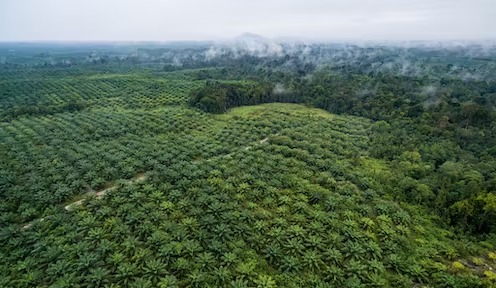
Despite a 2013 pledge by major palm oil firms to maintain environmentally friendly operations, a recent report by environmental group Earthqualizer revealed that more than 440,000 hectares of forest and peat land (roughly three times the size of London) have been cleared for oil plantation in Indonesia between 2016 and 2021; and 210,000 hectares in Malaysia and Papua New Guinea.
The pledge – known as “No Deforestation, No Peat, No Exploitation” (NDPE) policy – banned the companies from cutting down trees in forests and damaging wetland areas. The failure to comply supposed to result in sanctions from buyers.
Despite that pledge, the Earthqualizer report found 116 big companies (mostly Indonesian companies) still destroyed more than 1,000 hectares of forest and peatland, 25 of the corporate groups even did it between 7,000-35,000 hectares. This shows that pledge is being ignored and the sanctions are not effectively enforced.
This has became a challenge to transform palm oil industry to be more sustainable. To overcome it, we need to find a mechanism that also benefits millions of small farmers who rely on palm oil for their livelihood.
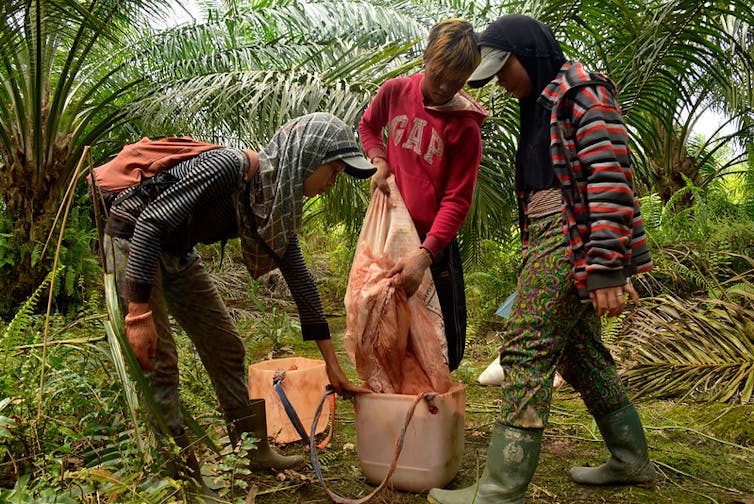
Soil fertilisation at palm oil plantations in West Kalimantan Province, Indonesia. Icaro Cooke Vieira/CIFOR, CC BY-ND
Fixing a broken promise
In 2019, Indonesia put in place strict rules for palm oil companies by issuing a permanent ban on turning natural forests into land for palm oil production. The government also put a three year freeze on building new palm oil plantations.
Because of these rules, deforestation and peatland clearing for palm oil plantation slowed down from 2019 to 2021, according to the October 2022 Earthqualizer report.
But government policies aren’t the golden ticket to make sure palm oil suppliers follow the rules. Companies in the supply chain also need to ensure that the regulations are being followed.
When purchasing palm oil, any buyer must ensure that the product is sourced from sustainable practices. To do this, buyers must set up an accountable and transparent monitoring system. This system will provide an immediate response, such as freezing trade with non-compliant suppliers, if the companies are proven to have damaged forests and peatlands in their supply chain.
However, non-compliant palm oil suppliers can appeal as long as they show commitment to sustainable practices.
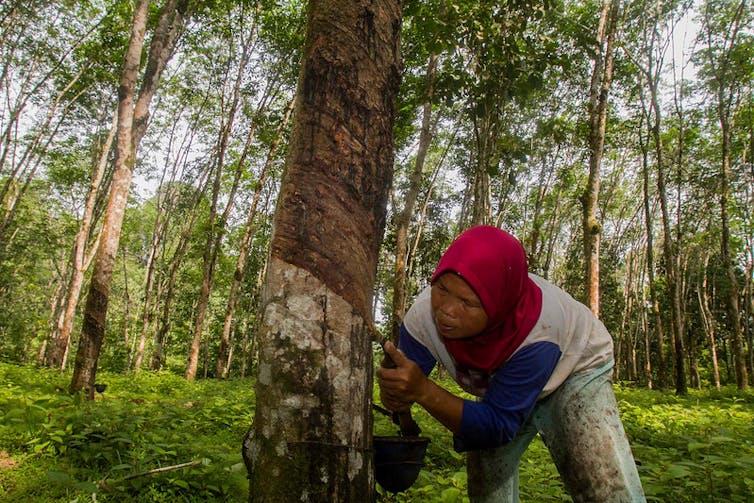
A Lubuk Beringin villager, Zulita, taps a rubber tree on her farm at Lubuk Beringin village, Bungo district, Jambi province, Indonesia. Tri Saputro/CIFOR, CC BY-ND
Under the system, buyers can ask palm oil suppliers to restore any land that they’ve damaged. The suppliers are then required to prove that they’re trying to fix things by making a clear plan for how and when they’ll conduct recovery and restore the land.
Restoring land is not only about planting trees, but also protecting and managing the recovered forests. Recovery is not only about land restoration, but also recovering local economies.
One way to do it is by involving local communities. The palm oil companies can create recovery plans, in which they will restore the forest and help improve the livelihoods of nearby communities by selling byproducts like rubber or candlenut for the community. This also aligns with the Indonesian government’s plan to give 12.7 million hectares of forest land to communities through social forestry projects.
Involvement from all
To reassure the public that the palm oil industry is making improvements, all parties in the palm oil supply chain must commit to restoring forests and peatlands.
Money is not really an issue here.
A non-profit conservation group called The Forest Conversation Fund estimates it would cost US$35 million per year to recover the 877,314 hectares of forest. The number is quite miniscule compared to the value of palm oil industry, which is estimated to be worth US$63.7 billion.. A one-time payment for a full 25-year recovery plan will cost only 1.3% of the net worth of the industry.
Consumers can also play a role in it by only buying products from companies who are putting consistent efforts to comply with the No Deforestation policy.
All we need is a solid commitment from the palm oil industry to continuously support the global sustainability agenda.