
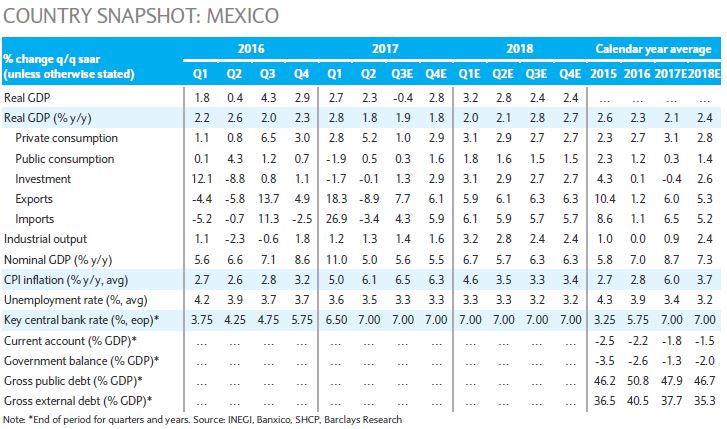
Mexico’s gross domestic product (GDP) is expected to fall by 0.45 basis point in the event of a NAFTA breakup, a possibility that has been discussed in the media recently. Long-term growth would likely decline to 2.0 percent from 2.5 percent currently. Nevertheless, a permanent real depreciation of the peso could also offset this effect, Barclays Research reported.
In particular, Mexican authorities have made clear that it will not concede these proposals and the government is working on a “Plan B,” in case President Trump decides to pull out from the agreement. This plan includes expanding free trade agreements with Argentina, Brazil, and Japan, and to continue the TPP discussions.
In a scenario of a US exit from NAFTA, the likely scenario for Mexico would be the application of Most Favored Nation (MFN) tariffs agreed on by the World Trade Organization (WTO). It highly unlikely that the US would deviate from WTO rules by imposing generalized tariffs on Mexican imports. This action would make the US vulnerable to retaliation from other nations leading to a situation out of the scope of NAFTA.
The textile production sector would be hit the hardest; Mexican exports to the US could potentially fall 4.8 percent in the short run and 9.7 percent in the long run. However, this subsector represents only 0.7 percent of GDP and exports with 62 percent of Mexican value added. Processed food exports could decline 2.6 percent in the short run and 3.8 percent in the long run, which would be a more notable drag on the economy (4.5 percent), the report added.
FxWirePro launches Absolute Return Managed Program. For more details, visit http://www.fxwirepro.com/invest

