
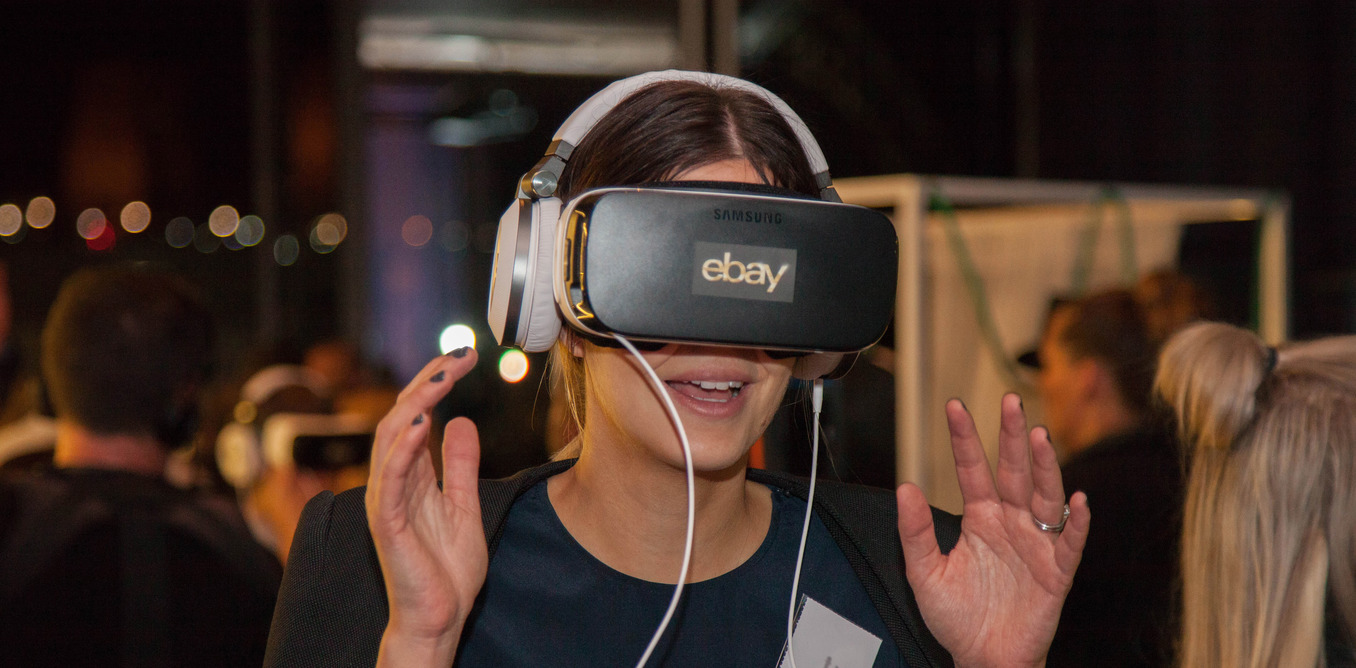
Department store Myer and online shopping giant eBay have teamed up to offer something different to consumers in a bold bid to change the way we shop, interact with, research and purchase products.
Their creation of a virtual reality (VR) department store – a place where consumers can shop if they are unable to visit Myer’s bricks and mortar stores - enables them to challenge the retail status quo.
Whether it came about by chance, intuition or meticulous research, the new offering is an experiment in sensory marketing. This is an area of marketing that combines perception, sensation and cognition.
How we use our senses to shop
There’s been a recent rush towards the field of sensory marketing, which was first pioneered by Professor Aradhna Krishna.
Krishna defines sensory marketing as “marketing that engages the consumers' senses and affects their perception, judgment and behaviour". Essentially, sensory marketing considers how a consumer sees, tastes, touches, smells and even hears the product and/or service experience. Sounds like common sense, but the uptake by retailers and managers to incorporate sensory elements into their products, stores and exchange designs has been slow. This is intriguing considering the plethora of emerging evidence on the power sensory modalities have on our decision making.
We use our senses to navigate our world and shape our decisions. Incorporating sensory elements into physical settings may be relatively easy, but an online environment presents a much harder, yet equally as important challenge. The Myer/eBay initiative is definitely a step in the right direction.
The service incorporates both vision and touch. It facilitates a means for consumers to connect with their brands in a new and novel way. I can hear you saying, “Don’t we look at products all the time normally?” “How are you touching the products?” There are two answers. First, customers have to hold the VR system in their hands and against their face. By doing this they are physically connecting their skin receptors to the VR department store. This could facilitate what is known as an endowment effect.
Secondly in terms of vision, customers are looking at products in a very different way. They have a deep and sustained focus, something they have unlikely embraced before. Research suggests that a deeper and longer visual fixation on products and brands during visual search may create positive connections in consumers’ minds. What this means for purchase behaviour in the VR store only time can tell.
Where to next?
With the deep focus required to operate the VR department store, opportunities are available to expose consumers to subliminal imagery which could be used to trigger a favourable response. Further sensory opportunities exist by providing congruence of sight, sound and touch during the shopping experience. It’s likely smartphone manufacturers will soon start building eye tracking technology into their devices so this type of shopping becomes commonplace. HOW WOULD THIS WORK? ISN"T A SMARTPHONE SCREEN TOO SMALL? (Honestly I am not sure… However, I think it will be possible - an eye tracker is just a camera that takes a lot of photos of a user’s eyes per second, i.e. 120Hz = 120 photos per second. A mathematical algorithm is then used to match the photos with where the eyes would be looking on the screen. As long as a calaboration is performed beforehand it should be possible - theoretically. A lot of interest is present in the video game domain where users should be able to play with their eyes, i.e. slicing fruit. Tobii is the world leader in eye tracking technology and they encourage developers to use their systems in new and novel ways.)
Initially at least, the VR department store may see a reciprocity effect – where consumers who have received the free eBay VR device return in kind by spending hours in the virtual store and shopping above and beyond their discretionary budgets. The fear of course is the novelty will wear off quickly.
The challenge for the Myer/eBay alliance is to maintain any interest they attract and convert this interest into a real return on investment. In terms of online stores, maybe we have always been looking, now for the first time we may be seeing.
 David P. Harris does not work for, consult, own shares in or receive funding from any company or organization that would benefit from this article, and has disclosed no relevant affiliations beyond the academic appointment above.
David P. Harris, PhD Student - Sensory Marketing and Consumer Psychology / Sessional Lecturer in Marketing, CQUniversity Australia
This article was originally published on The Conversation. Read the original article.


