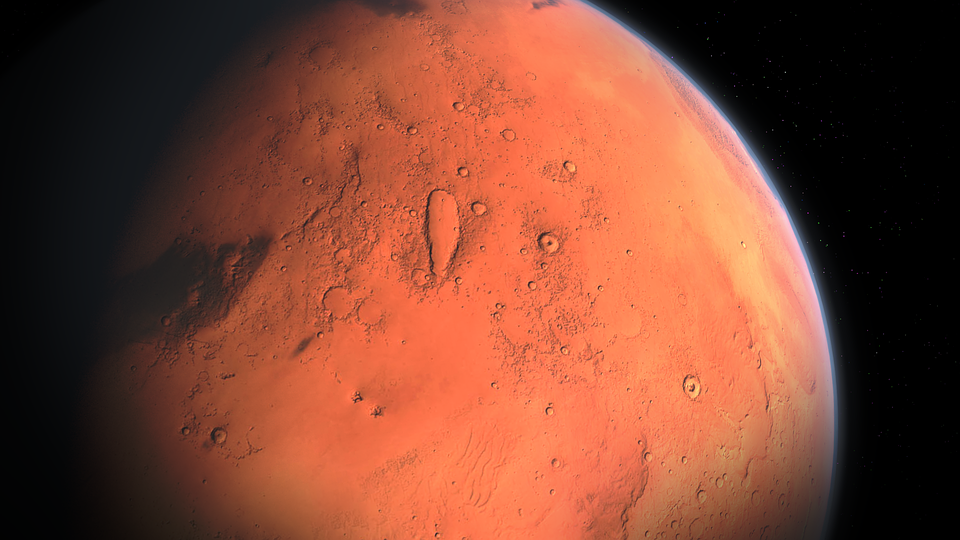
Over the coming years, we will be one step closer to being able to explore Mars, and over the course of over a decade might see the beginnings of colonizing the red planet. As NASA gears up for an upcoming Mars mission, the agency released a concept image of what would a base on the red planet look like.
Express reports that NASA has shared a concept image of what it might look like once humans have finally set foot on Mars. The concept art shows an astronaut standing in the midst of the canyons of Mars, looking at the expanse of terrain before them. “The artist’s concept shows an astronaut on Mars, as viewed through the window of a spacecraft. NASA is returning astronauts to the Moon and will test technology there that will be useful in sending the first astronauts to the Red Planet,” said the agency in a statement.
Before traveling to Mars, NASA is currently preparing for its Artemis mission which will bring the next set of people onto the surface of the moon. The launch is expected to take place in 2024, decades since the last time NASA was able to send astronauts onto the lunar surface in 1972. The astronauts that will be part of the Artemis mission will be tasked to build a Moon colony and laboratory that will become somewhat of a bridge to getting to the red planet. The Moon base and laboratory will act as a checkpoint between Earth and Mars while allowing for further studies of the moon.
Michael Collins was one of the three astronauts involved in the historic Apollo 11 mission, which saw the first men on the moon: Neil Armstrong and Buzz Aldrin. Collins piloted the Command Lunar Module for 21 hours as he waited for his colleagues to finish conducting their experiments on the surface of the Moon. It was there when he was referred to as the “Loneliest Man in the Universe,” however in a previous interview with NASA in 2009, Collins revealed that he did not feel that way.
Collins shared that he got to view the Earth from a great distance in space, which left a lasting impression on him. “I really believe that if the political leaders of the world could see their planet from a distance of 100,000 miles their outlook could be fundamentally changed,” said the astronaut.