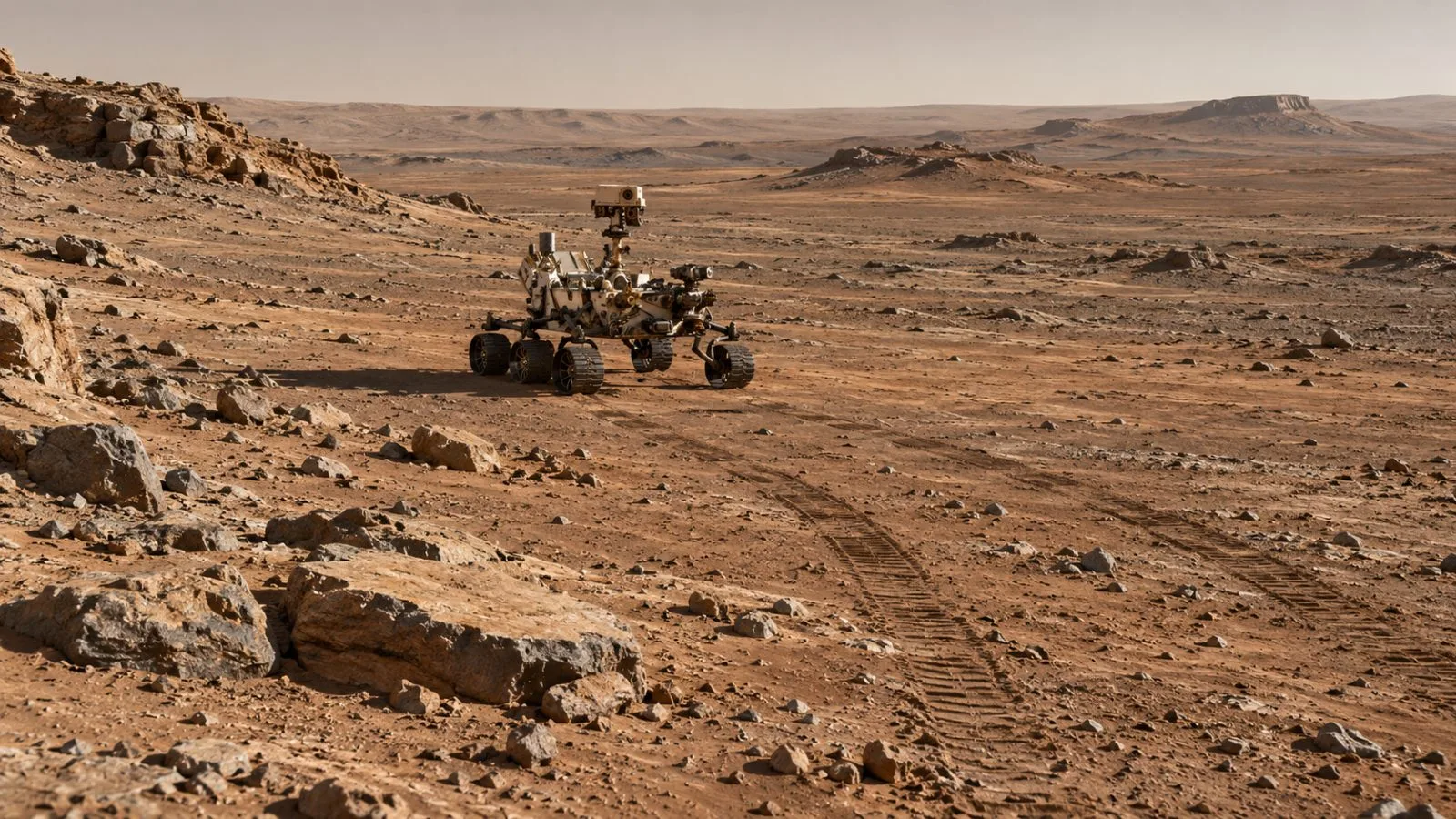
NASA's Perseverance rover photographed a dark rock beside likely fragmented material near Jezero crater, and scientists are weighing whether the rock belongs to an olivine-bearing unit or is heat-altered breccia.
The image shows two units at Tinga, a target near the southern edge of the Idubi channel outside Jezero crater. NASA says the rover’s left Mastcam-Z camera captured it Oct. 14, 2026, during Sol 2009 of the Mars 2020 mission. NASA describes Idubi as an outcrop composed mainly of olivine, an igneous mineral.
The lower material is likely a polymict breccia, NASA’s term for a rock containing angular pieces from multiple rock types. The mission team says an impact may have formed it. The event could have been a separate collision like the one that created Jezero, or the impact that formed Jezero itself.
The dark rock has two possibilities in NASA’s account. It may be part of Idubi’s olivine-bearing unit, or it may be breccia changed by heat where it met hotter rocks. NASA says additional work at the exposure is needed to distinguish between those explanations.
In a September update, NASA said Perseverance was exploring Lac de Charmes, west of Jezero’s rim, where the team had seen rocks with varied textures and compositions. It said the area’s evidence pointed to both igneous and impact processes. An Oct. 5 post described a candidate breccia at Idubi and said the team was checking whether nearby pale boulders were pieces that had eroded from it.
NASA has also reported that breccia layers outside Jezero have been attributed to asteroid impacts on early Mars. That precedent provides context for the impact explanation, but it does not confirm how the Tinga rocks formed.
Margaret Deahn, a Purdue University Ph.D. candidate and author of the NASA post, wrote: “Further in situ investigation of this particular outcrop is needed.”