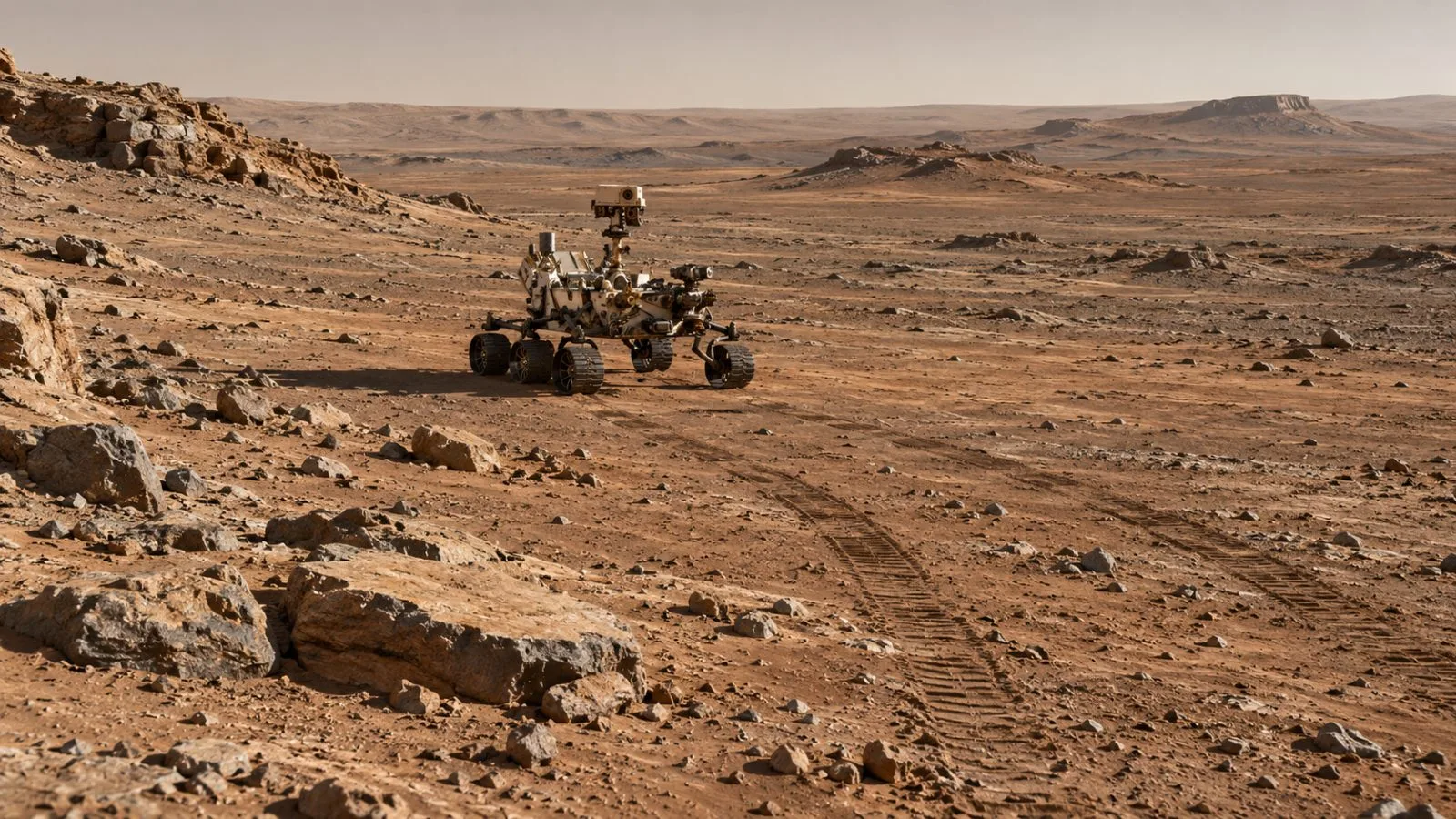
NASA’s Perseverance rover measured dust as small as about 100 nanometers on materials carried to Mars, findings that could help guide protective gear and habitat design without showing what astronauts might breathe.
The readings span 1,645 Martian days. NASA’s Jet Propulsion Laboratory said earlier Mars measurements could resolve particles only down to about 3 micrometers. Perseverance’s Planetary Instrument for X-ray Lithochemistry, or PIXL, detected fine particles smaller than 2.5 micrometers and ultrafine particles near 100 nanometers.
NASA’s account places particles on a PIXL basaltic-glass target and a Teflon swatch examined by the rover’s Scanning Habitable Environments with Raman and Luminescence for Organics and Chemicals instrument, or SHERLOC, in the 100–300 nanometer range. The study abstract describes particles as small as 100–200 nanometers across samples and calibration targets. On a PIXL Teflon target and a SHERLOC Vectran swatch, particles averaged about 2 micrometers.
The study, published in the Proceedings of the National Academy of Sciences, analyzed X-ray fluorescence data and modeling from Perseverance. It describes the dust as a mafic silicate enriched in phosphorus, iron and sulfur. “PIXL gave us the chance to measure it directly on Mars,” said Scott VanBommel, a Perseverance scientist at Washington University in St. Louis and lead author of the study.
NASA says electrostatic charging appears to affect which particle sizes adhere to different materials. The smallest grains were still on targets after years of rover driving and drilling, and some materials retained less dust than others. NASA says the findings could inform material and coating choices, dust-removal procedures, spacesuit and habitat design, and crew health standards. Suitports and dual-chamber airlocks could also limit dust entering living areas.
The measurements do not quantify airborne dust or astronaut exposure. NASA says airborne particles smaller than 2.5 micrometers on Earth can penetrate deep into the lungs and enter the bloodstream; the health risk from Mars dust would depend on the amount encountered and the duration of exposure.
Apollo provides a precedent for equipment concerns: NASA says lunar dust scratched visors, degraded outer suit layers and damaged seals. Some crew members reported hay-fever-like symptoms.