On September 26, after a nine-month journey through the Solar System, NASA’s Double Asteroid Redirection Test (DART) mission impacted an asteroid called Dimorphos.
NASA scored a bullseye, with DART – roughly the size of a vending machine – hitting Dimorphos within 10% of the 160-metre asteroid’s centre. The hit changed the orbit of Dimorphos around its bigger companion asteroid Didymos by more than 30 minutes, far exceeding the original goal.
This is the first time humans have deliberately changed the motion of a significant Solar System object. The test shows it’s plausible to protect Earth from asteroid impacts using similar future missions, if needed.
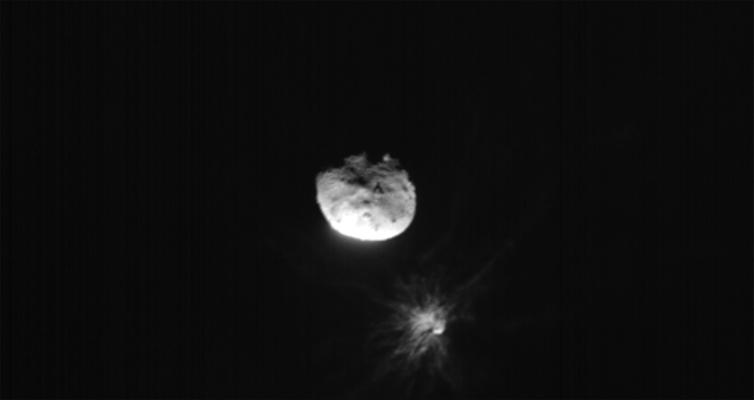
The Italian Space Agency’s LICIACube spacecraft acquired this image just before its closest approach to the Dimorphos asteroid, after the impact. Didymos, Dimorphos, and the plume of debris ejected from Dimorphos are clearly visible. ASI/NASA
An astonishing feat
The successful mission is an astonishing feat of science and engineering. In the final phases of approach before impact, DART autonomously steered itself to the impact site, processing images onboard the spacecraft and adjusting its trajectory without the intervention of humans.
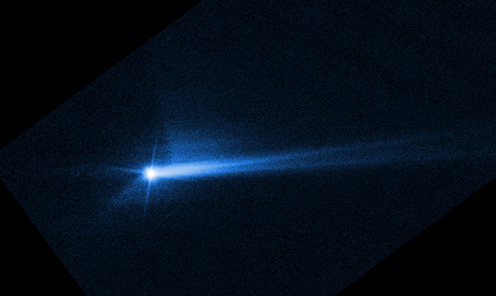
Many telescopes on Earth, and an Italian spacecraft that tagged along with DART, were able to obtain amazing images of the impact. Even small telescopes captured spectacular views, showing an enormous plume of debris from the impact that developed into a trail now following the asteroid through space.
The DART mission was the first test of planetary defence – the use of a spacecraft to change the trajectory of an asteroid.
In the future, such a technique could protect Earth from asteroid impact, if we detect an asteroid on a collision course with us. By changing the direction of an asteroid when it is far from Earth, a collision could be avoided.
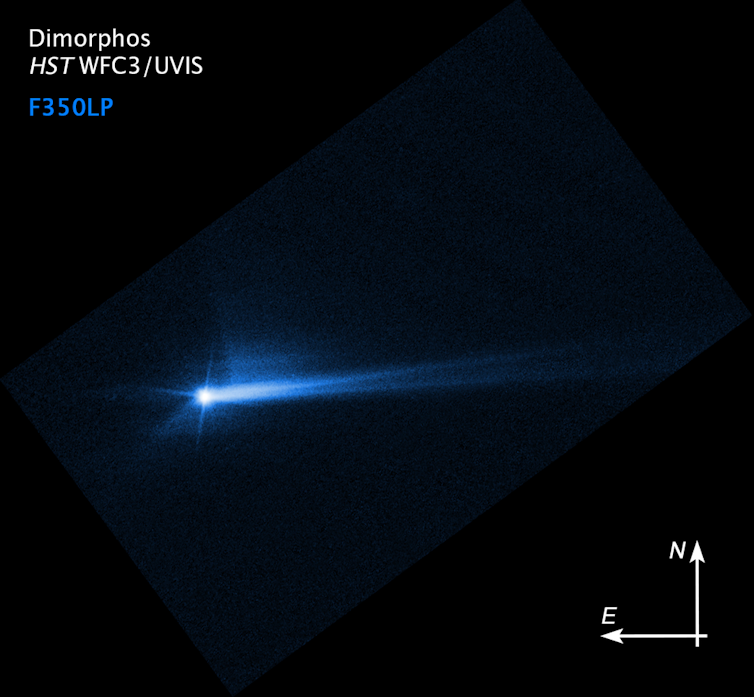
NASA’s Hubble Space Telescope shows Dimorphos 285 hours after the impact, with a tail of debris generated by the impact. NASA/ESA/STScI/Hubble
How was DART so successful?
Dimorphos was chosen as the target for DART because it is part of a double asteroid system – it orbits a larger, 780-metre asteroid called Didymos. Before the impact, this orbit was very regular and could be measured by large telescopes from Earth. Measurements showed the period of the orbit was about 11 hours and 55 minutes.
The DART mission goal was to show the orbit of Dimorphos would be changed by the impact, which took place 11 million kilometres from Earth, with the spacecraft travelling at 25,000 kilometres per hour.
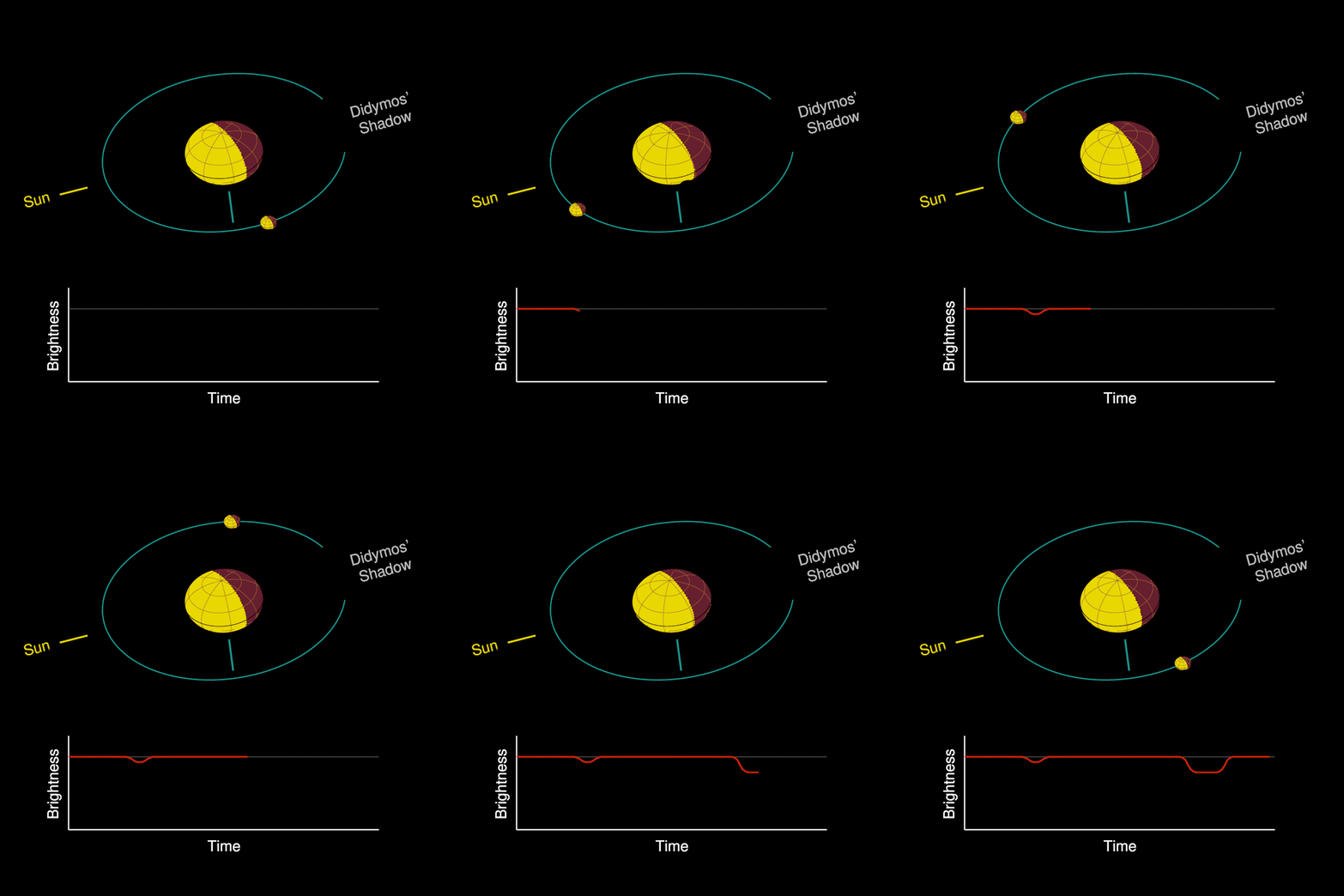
A zoomed-in view of the orbit of Dimorphos around Didymos. Astronomers can measure the orbit by detecting dips in the brightness of the light the asteroid pair reflect from the Sun. A small dip occurs when Dimorphos eclipses Didymos, and a bigger dip the other way around. NASA/APL/UMD
Telescopes on Earth measured the orbit before and after the impact. The minimum change to the orbit to declare mission success was 73 seconds.
The data are in and DART changed the orbit of Dimorphos by a whopping 32 minutes (plus or minus 2 minutes).
The change is large, partly because of the resulting debris plume. The act of throwing all that debris off the asteroid generated a recoil, like the recoil of a gun; the bullet is fired in one direction and the gun recoils in the opposite direction. It’s the same with the debris plume and the asteroid.
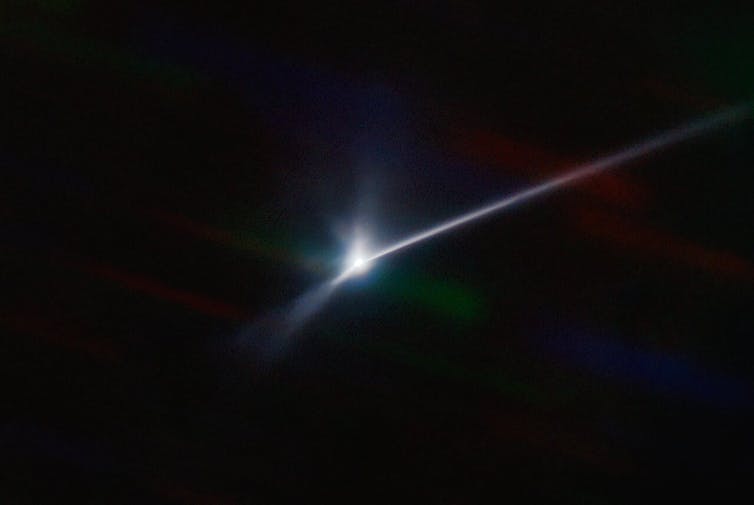
A side view of the streams of material from the surface of Dimorphos two days after impact. On the right, the material is forming a more than 9,500-kilometre-long comet-like tail, pushed into shape by pressure from the Sun’s radiation. CTIO/NOIRLab/SOAR/NSF/AURA/T. Kareta (Lowell Observatory), M. Knight (US Naval Academy)
Good news for planetary defence
By any measure, DART has therefore been a huge success. DART made a bullseye and showed that missions like this can alter the trajectories of asteroids. The idea has been around for a long time, and has inspired many asteroid movies. Now, engineering and science have caught up.
If, in the future, an asteroid is found to be on a collision path with Earth, and we have enough warning, a next-generation mission based on the DART experience could well save Earth and humanity from significant losses.
DART cost approximately US$324 million, and at this point it looks like money well spent.
As more data on the impact are analysed, planetary defence techniques can be refined. We will also learn a lot about asteroids from the data collected. A European mission is planned to go to the Didymos/Dimorphos system and take a close look at the impact crater, which will provide even more detailed information.