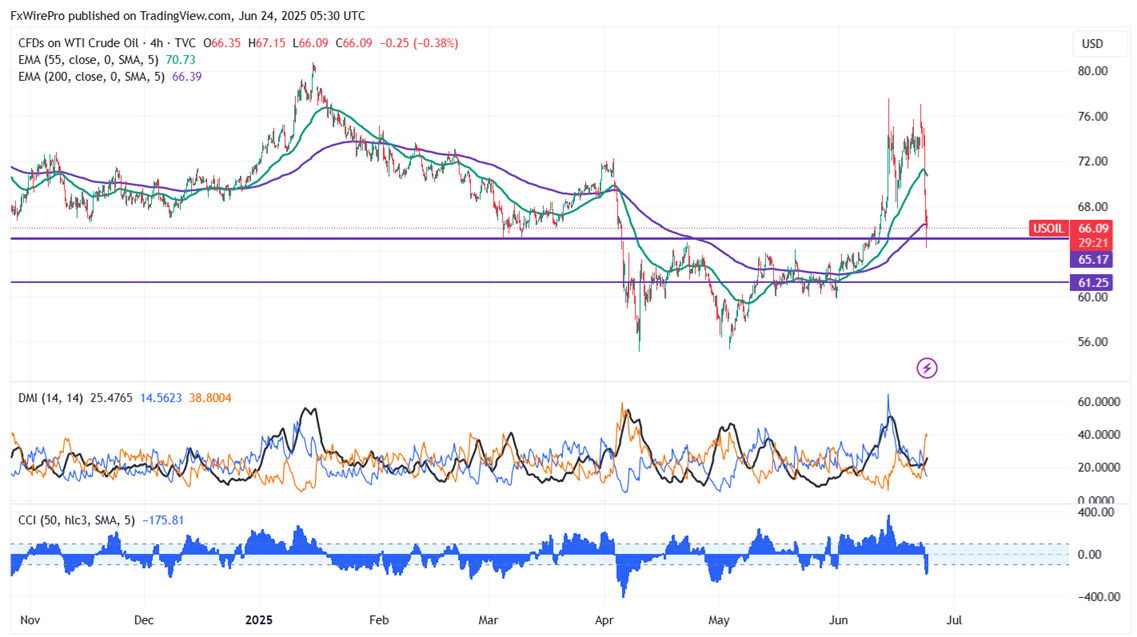
Crude oil prices declined sharply following the announcement of a ceasefire agreement between Iran and Israel. It hits an low of $64.35 and currently trading around $66.31.
On June 23, 2025, former U.S. President Donald Trump announced a "complete and total ceasefire" between Iran and Israel, bringing an end to their twelve-day armed conflict. The ceasefire was phased, with Iran ceasing hostilities within six hours and Israel following twelve hours later, leading to a full cessation within 24 hours. Iran's Foreign Minister, Abbas Araghchi, confirmed the halt, noting military actions continued until 4 a.m. local time and stating Iran would cease retaliation if Israel stopped attacks. The conflict involved Iranian missile strikes on Israeli cities and Israeli attacks on Iranian nuclear sites, escalating after U.S. strikes on Iranian nuclear facilities. While Iran responded with missiles on a U.S. base in Qatar, Trump called it a "very weak response" with no U.S. casualties. This de-escalation was a result of intensive diplomatic efforts, with Qatar playing a key role in mediating the U.S. proposal, supported by the international community.
Price Resistance and Support Levels
The near-term resistance is around $68; any breach above this level could push prices higher to $70/$70.80/$71.80.On the downside, immediate support is at $64 violation below targets $62/$60/$57.97/$55.
It is good to sell on rallies around $68.80-$69 with a stop-loss around $71 and a target price of $60/$55.