MILLWOOD, Va., Feb. 29, 2016 -- Project HOPE, the global health education and humanitarian assistance organization, today is launching a new initiative in the Ranchi District of Jharkand State, India with funding from Boston Scientific Corporation aimed at reducing the burden of three of the most common noncommunicable diseases (NCDs) – diabetes, hypertension and cardiovascular disease.
|
|||||
According to 2014 data from the World Health Organization, NCDs are estimated to account for 60% of all deaths in India. The death toll due to NCDs in India is expected to increase from 38 million in 2012 to 52 million in 2030. These statistics are largely due to urbanization and economic improvements, which have led to increased life expectancies, changes in diet, decreases in physical activity and an increasing prevalence of obesity, particularly among children.
Currently, a lack of trained health care workers and ill-defined roles among the different health sectors (i.e., public, private and volunteers) for providing care and treatment are all significant barriers to combating the growing burden of NCDs in India.
In implementing the new, one-year program, which will be called United Dialogue and Action Against Noncommunicable disorders (UDAAN), Project HOPE will work collaboratively with the government of Jharkhand State to more effectively implement the National Program for Prevention and Control of Cancer, Diabetes, Cardiovascular Disease and Stroke (NPCDCS) guidelines, which were established by the government of India to combat the growing burden of NCDs.
"The new UDAAN program embodies Project HOPE's mission and philosophy of 'helping people to help themselves' by working in this public-private partnership so that the Jharkand State health ministry can promote wellness and train health workers themselves," said Linda Heitzman, Project HOPE's Executive Vice President. "With the support of Boston Scientific and employing this training model, Project HOPE will be able to have a lasting and sustainable impact on the health of Jharkand State and its ability to fight NCDs for years to come."
Some key activities of the program will include:
- Community-wide health fairs, which provide screenings, lifestyle education, group exercise classes and interactive educational activities
- Training of NPCDCS workers, with a particular focus on active screening, counseling, management and timely referrals
- Improving treatment capabilities and referral networks for NCD clinics
- Developing educational materials for the training of health workers in NCDs
In addition to its support of UDAAN, the Boston Scientific Corporation is also funding an initiative in South Africa that Project HOPE is supporting to screen eight million people for diabetes and hypertension.
"Noncommunicable diseases represent a multifaceted problem that calls for a sophisticated approach," said Michael F. Mahoney, president and CEO of Boston Scientific. "As a company dedicated to addressing unmet patient needs, we are proud to support Project HOPE's work in India and South Africa to improve detection and diagnosis of NCDs and access to quality healthcare services."
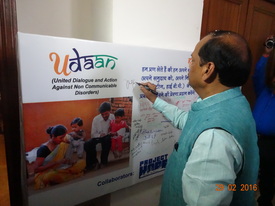
A ceremony to launch UDAAN took place today at the Chanakaya BNR Hotel in the Ranchi District, Jharkhand State, India. High-level officials from the Jharkand State Ministry of Health, Project HOPE and Boston Scientific attended the ceremony.
Project HOPE has been working in India since 2007, when the organization launched a four-year program to educate health care providers in best practices for the prevention and treatment of diabetes. Since that time, Project HOPE launched the India Diabetes Educator E-Learning Program (IDEEL), a groundbreaking online learning program endorsed by the International Diabetes Federation. The organization is also currently participating in Project UDAY in Sonipat and Vishakhapatnam, India, where it is involved in training health workers in the prevention and treatment of diabetes.
About Project HOPE
Founded in 1958, Project HOPE (Health Opportunities for People Everywhere) is dedicated to providing lasting solution to health problems with the mission of helping people to help themselves. Identifiable to many by the SS HOPE, the world's first peacetime hospital ship, Project HOPE now provides medical training and health education, and conducts humanitarian assistance programs in more than 35 countries. Visit our website projecthope.org and follow us on Twitter @projecthopeorg.
A photo accompanying this release is available at:
http://www.globenewswire.com/newsroom/prs/?pkgid=39193
CONTACT: Geraldine Carroll gcarroll@projecthope.org
         Tel. +1.540.257.3746