


 China Shuts 670 Banks as Bitcoin Eyes Financial Risks
  Fed’s Logan Signals 50 Basis Points More in Rate Hikes
  High Rates Weigh on U.S. Home Improvement Demand
  Cardano ADA Jumps 10% as RealFi and Dijkstra Upgrade Fuel Rally
  Yen Sinks as BOJ Rate Hike Fails to Impress Markets
  BOJ Signals Faster Rate Hikes as Inflation Risks Grow
  Strategy’s STRC Nears $100, Raising Prospects for Major Bitcoin Buys
  AAVE, PUMP, WLD and SKY Rally as Crypto Market Slips
  Stellar Leads RWA Tokenization Growth With $36.4M Inflow
  BlackRock’s Rick Rieder Favors Bonds Over Stocks as Treasury Yields Surge
  Fed’s Hammack Says More Data Needed Before Next Rate Move
  RBA Says ASX Still Falls Short on Governance and Risk Controls


 Add as a preferred source on Google
The Monetary Policy Committee of the Reserve Bank of India chose on Friday, June 5, 2026, to stay neutral and unanimously voted to keep the repo rate at 5.25%, therefore supporting stability over urgency. With the marginal standing facility at 5.50% and the standing deposit facility at 5.00%, all six members agreed on the status quo. Governor Sanjay Malhotra stressed especially the ongoing US-Iran war in West Asia, stressing that the choice to stay passive was mostly driven by more inflation threats brought on by rising geopolitical conflicts. Given the ambiguity of commodity markets all around, the central bank decided to watch and wait rather than impose fresh stimulus or restriction.
The RBI's revised estimates provide a rather upbeat view for production but a more cautious one for pricing on the growth-inflation seesaw. The GDP growth estimate for FY26 was increased to 7.6% from 7.4%, hence demonstrating confidence in the resiliency of the domestic economy, even if the FY27 projection stayed at 6.9%. Nevertheless, the inflation outlook deteriorated: the RBI raised its FY27 inflation prediction from 4.2% to 4.6% even though current customer inflation is significantly below the target at 3.48%. Malhotra said that even if basic inflationary pressures are now under control, legislators have to closely monitor any secondary effects that could show up across the economy.
The action was precisely in line with market predictions since experts and traders had projected the RBI would hold off on any rate modification till the full consequences of increasing global oil costs and a depreciating rupee were evident. Beyond the West Asian battle, the central bank observed a number of hazards compromising price stability, including unexpected currency swings and a below-normal monsoon prediction that might spark food inflation. The RBI may effectively impose a risk premium on geopolitical peace by abstaining from forward guidance and holding rates; it would want to keep its ammunition dry while the outside world is still dangerously dynamic.
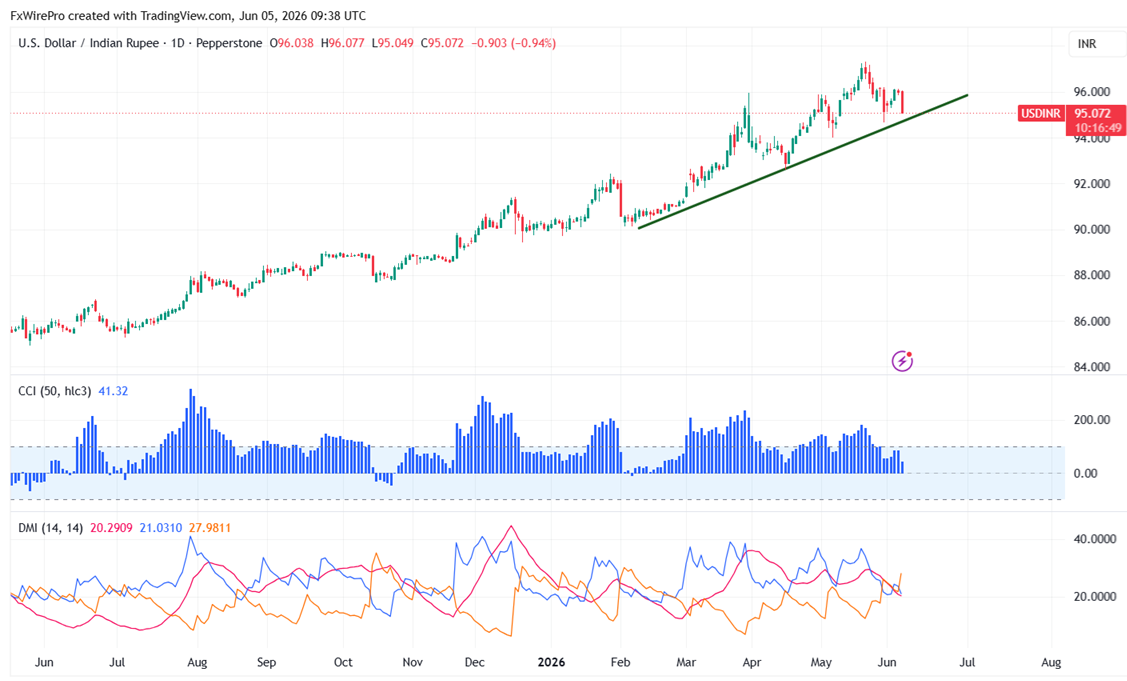
USDINR pared some of its gains after the RBI rate pause, after hitting an all-time high of $96.96. It hits an intraday low of 95 and is currently trading around $95.05.
Technicals-
Major resistance- 97,98,100
Near-term support - 94.40/94/93.36
Trend reversal level- 91.45







