The European Maritime Safety Agency (EMSA) says its CleanSeaNet service can alert authorities within 30 minutes of satellite image acquisition, while RMIT University’s oil-skimming robot remains a laboratory prototype, highlighting the different readiness levels of response tools.
CleanSeaNet uses synthetic aperture radar to scan sea areas at night and through fog or clouds. A detection identifies possible oil pollution, not a confirmed spill: some natural features also appear as dark patches in radar images. EMSA says authorities may send aircraft or vessels to check a detection.
That verification challenge also affects automated classification. A 2025 study examined Sentinel-1 images near the northern entrance to the Suez Canal using DeepLabv3+ models trained on different datasets. The model trained on CleanSeaNet data missed parts of some larger spills, while one trained on Egyptian data sometimes classified surrounding water as oil, the researchers reported.
Aircraft data and coordinated mapping systems are also being tested. A 2025 global survey by researchers affiliated with Environment and Climate Change Canada found that 12 of 23 respondents used or obtained data from remotely piloted aircraft systems. None reported fully automated spill detection, delineation and classification using that data. A separate 2019 study evaluated a coordinated aircraft-mapping algorithm in simulation.
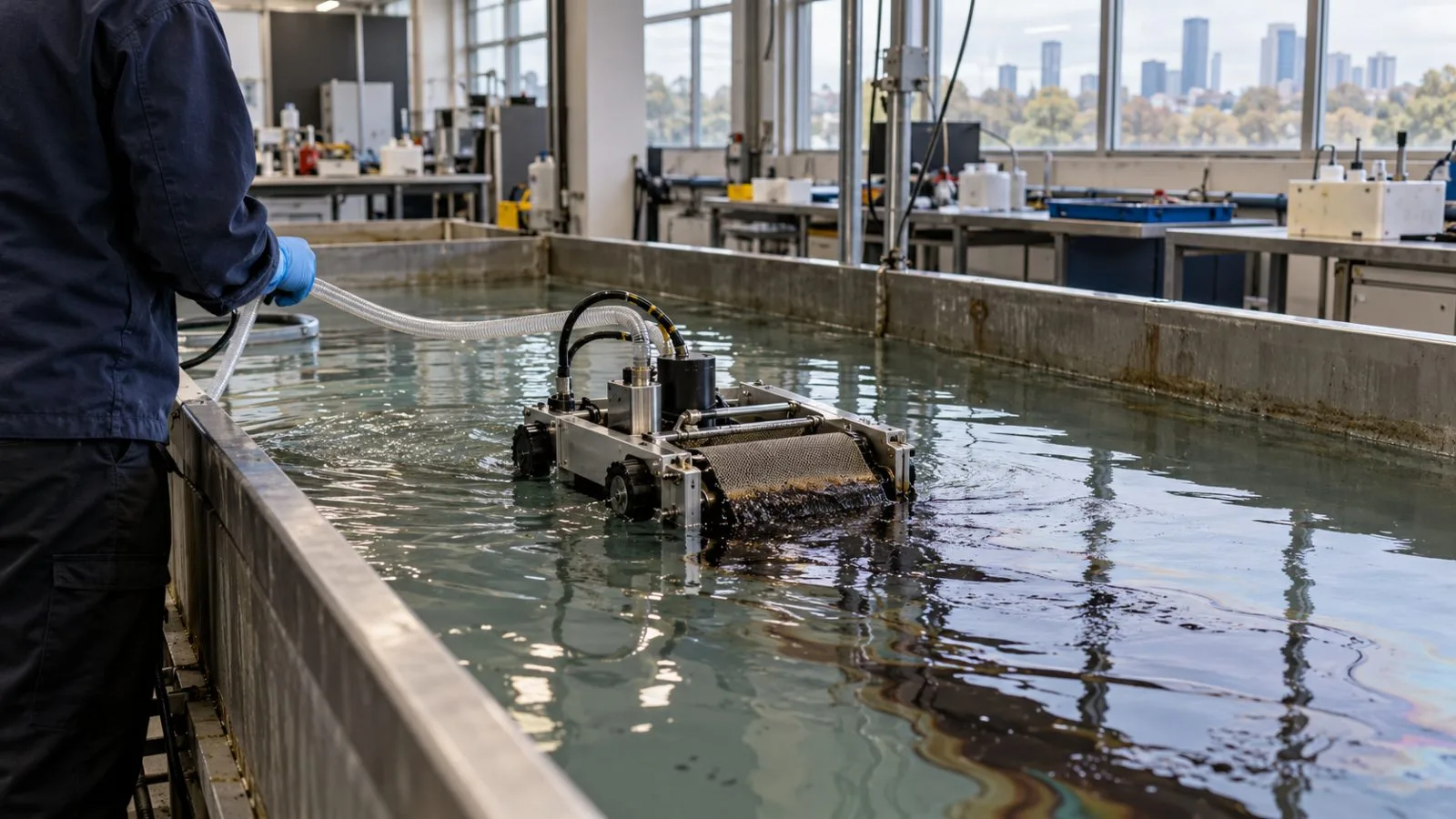
At the recovery stage, RMIT’s Wi-Fi-controlled minibot is designed to draw oil through a water-repellent filter. In laboratory tests, it collected about two milliliters per minute, and the recovered oil had purity above 95%, according to the research paper. The study recorded no filter clogging or water crossing the barrier during a five-minute run. RMIT says the robot runs for about 15 minutes per charge. “We wanted to create a system that can be deployed quickly, steered accurately,” said Dr. Md. Ataur Rahman of RMIT’s School of Engineering.
The U.S. National Oceanic and Atmospheric Administration (NOAA) lists booms, skimmers, dispersants and in-situ burning among oil-spill response options; the choice depends on the spill and location. RMIT’s next development work includes field trials and extended checks on the robot’s durability.